RSV in Babies and Kids: What to Expect and What Actually Helps

RSV has a special talent for showing up when your week is already full — in the middle of a busy stretch, after a few nights of bad sleep, or at 2 a.m., when you’re watching your baby breathe and wondering, Is that normal? The good news? Most cases can be managed at home with supportive care. The important part is knowing what’s expected, what actually helps, and what signs mean it’s time to get your child checked.
What Is RSV?
RSV, or respiratory syncytial virus, is a very common respiratory virus that usually starts out looking a lot like a regular cold: runny nose, congestion, cough, decreased appetite, and sometimes fever or wheezing.
For most kids, RSV stays mild and gets better on its own. In babies and young children, though, RSV can sometimes affect the smaller airways in the lungs. Inflammation and extra mucus in those tiny airways can make breathing noisier or more difficult and can make feeding harder — especially for babies who are trying to breathe through a congested nose while also taking a bottle or nursing.
One of the tricky things about RSV is that it may not look particularly dramatic on day one. Symptoms often begin like a cold and can become more noticeable over the next few days. In very young babies, RSV can also look different: they may be more irritable or sleepy, eat less, or have breathing changes without ever developing much of a fever.
What RSV Usually Looks Like
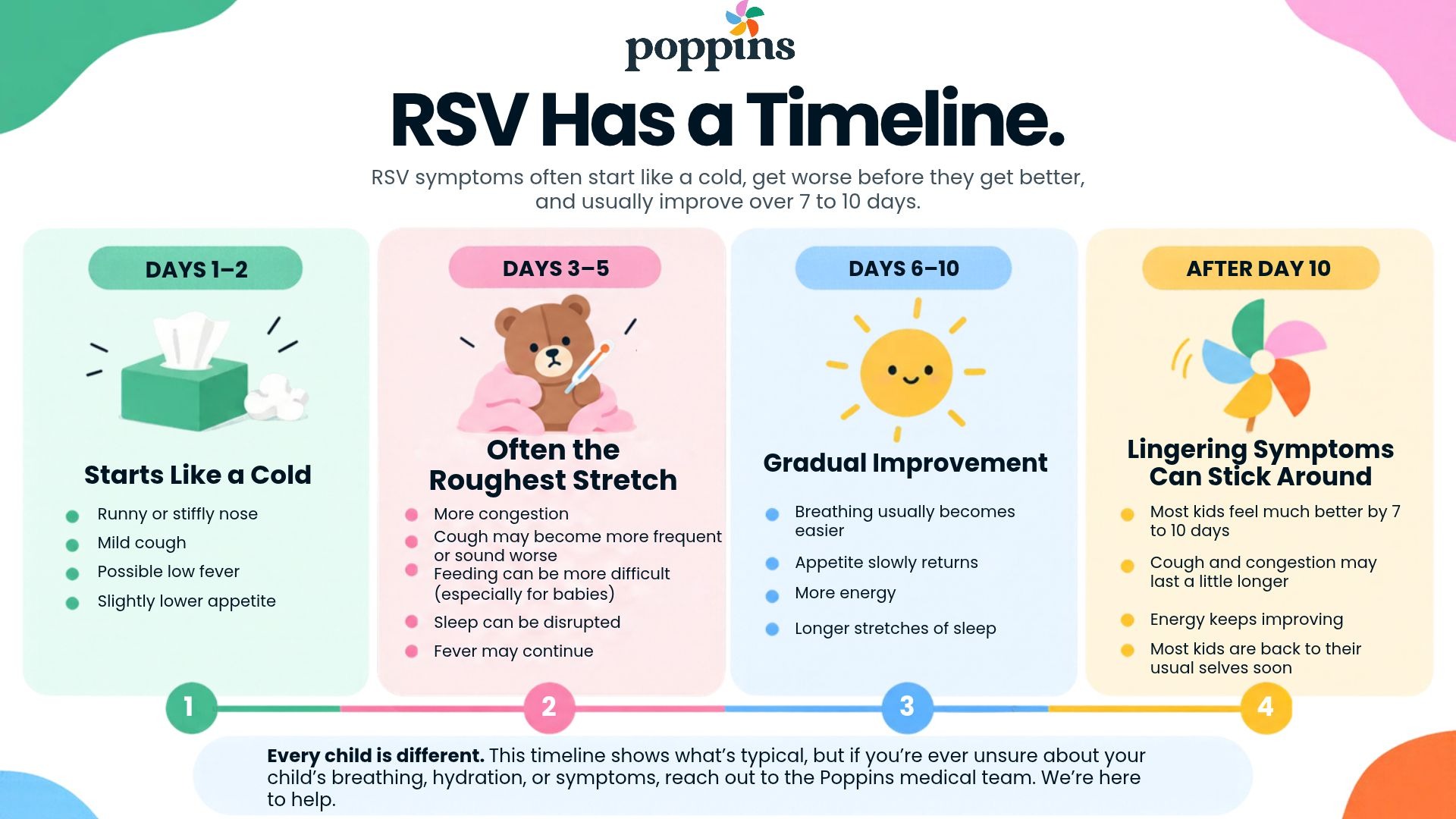
The timing matters. RSV symptoms often get worse before they get better, with the roughest stretch commonly falling around days 3 to 5 of the illness. That can be unsettling when your child seems manageable on day one and suddenly sounds much more congested two days later.
For babies, feeding is often one of the first things parents notice changing. A stuffy nose makes it harder to breathe and eat at the same time, so they may take less at each feeding, need more breaks, or do better with smaller feeds more often. Sleep may also be messier than usual thanks to all that congestion.
Most children gradually improve over about 7 to 10 days, although the cough and congestion may hang around a little longer. What you want to see over time is a gradual return of appetite and energy, easier breathing, and longer stretches of comfortable sleep.
RSV TImeline
How to Help at Home
There isn’t a medication that cures RSV, so treatment is mostly about keeping your child comfortable, hydrated, and breathing as easily as possible while their body clears the virus.
Clear the nose before feeds and sleep
Saline drops or mist can help loosen thick mucus, followed by gentle suction if your baby is too congested to eat or sleep comfortably. You do not need to suction constantly — focus on the times when congestion is actually getting in the way, especially before bottles, nursing, naps, and bedtime.
Think smaller, more frequent feeds
Babies with RSV may not take their usual amount at once, and that can be okay. Smaller feeds more often are often easier when they are congested and feeding takes more effort.
The bigger picture matters more than one disappointing bottle. As Mary Clare Zak, CPNP, explains, “I’m looking at the trend — are they still taking fluids throughout the day and having regular wet diapers?” A clear drop in urine output, a dry mouth, no tears when crying, or refusing fluids are signs your child may be getting dehydrated and should prompt a check-in with Poppins.
Use a cool-mist humidifier
A cool-mist humidifier can help keep the air from feeling so dry and may make congestion a little easier to manage. Keep it near where your child sleeps, and clean it regularly so you are not trading RSV for a humidifier full of mold.
Treat fever and discomfort, not the virus
Acetaminophen or ibuprofen can help with fever or discomfort when appropriate for your child’s age. They will not shorten RSV, but they can make a miserable kid more comfortable while the illness runs its course.
Antibiotics do not treat RSV, and bronchodilators or steroids are not routinely helpful for uncomplicated RSV in most children.
When RSV Needs More Than Home Care
The biggest things to watch with RSV are breathing and hydration. A child can sound incredibly congested and still be okay at home, but there are certain changes that mean it’s time to check in.
Reach out to Poppins if:
- Your child is breathing noticeably faster than usual
- You notice some pulling in around or between the ribs when they breathe
- Their nostrils are flaring with each breath
- Their breathing is becoming wheezy or noticeably noisier, and you’re not sure whether what you’re hearing is normal
- They are drinking significantly less than usual — especially a young baby taking less than about half of their normal feeds
- They are having fewer wet diapers or showing signs of dehydration, such as a dry mouth or no tears when crying
- Your baby is under 3 months and has a fever of 100.4°F (38°C) or higher
- Symptoms are getting worse after about day 5 instead of beginning to improve
- Your child is still not improving after about 10 days
- You’re uncomfortable with how they are breathing or feeding
Retractions — the pulling-in you may see between the ribs, under the ribs, or near the base of the neck — are a sign that your child is working harder than usual to breathe. Even mild retractions are worth checking in about, especially in a young baby.
If your child is having pauses in breathing, turns blue or gray, is struggling significantly to breathe, or is extremely difficult to wake, seek emergency care.
If you’re staring at your child wondering whether what you’re seeing or hearing is normal, reach out to Poppins. Our medical team can help you sort through the symptoms and understand what to do next.
Can RSV Be Prevented?
Yes — and this is one area where RSV prevention has changed quite a bit in recent years.
There are now two ways to help protect babies from severe RSV: an RSV vaccine during pregnancy or a long-acting antibody given to the baby after birth.
The RSV vaccine, Abrysvo, can be given between 32 and 36 weeks of pregnancy during RSV season. Babies can also receive an RSV antibody, such as Beyfortus (nirsevimab) or Enflonsia (clesrovimab), which provides ready-made protection during RSV season.
Most babies only need one approach or the other, not both. Which option makes sense depends mostly on whether the RSV vaccine was given during pregnancy and when your baby was born.
TL;DR
RSV usually starts like a cold and often gets worse before it gets better, with symptoms commonly peaking around days 3 to 5. Most kids recover with supportive care at home: saline and suction when congestion is interfering with feeds or sleep, smaller and more frequent feeds, fluids, and a cool-mist humidifier. Keep a close eye on breathing and hydration, and reach out to Poppins if your child is breathing faster or harder than usual, feeding much less, having fewer wet diapers, or simply making you wonder if what you’re seeing is normal.
RSV can be noisy, messy, and exhausting, but you do not have to figure out every cough, wheeze, or weird breathing sound on your own.
What are you watching most closely right now — breathing, feeding, fever, or whether your child seems like themselves?
If you’re not sure what to make of your child’s symptoms, reach out to the Poppins medical team. We can help you sort through what you’re seeing, what you can do at home, and what your next step should be.