Is It Bullying? Things That Parents Can Do Before, During, and After

There isn’t a phrase that makes a parent’s stomach drop as quickly as “Someone at school is being mean to me.”
Bullying is common. According to a nationwide CDC survey, approximately one in three teenagers between the ages of 12 and 17 reported that they had been bullied, picked on, or deliberately left out over the past year. So if this is showing up in your house, know you’re not the only one.
What Bullying Actually Is
The CDC defines bullying as any unwanted aggressive behavior that occurs over a period of time due to an imbalance of power that is likely to occur again. It may take the form of physical, verbal, social (such as spreading rumors or excluding someone), or online behavior.
Look for repetition, harm, and a power imbalance – the kind of power that comes from being bigger, more popular, having more friends, or knowing something embarrassing about the other child. If two children have roughly equal power, is it then considered conflict and not bullying according to the already mentioned CDC survey. Playful teasing and a single mean comment should be taken seriously, but do not require a severe response.
The label matters because if every disagreement is considered “bullying,” then the term loses its significance, and those children who are actually being targeted end up being included with typical playground disputes. Although not every difficult situation constitutes bullying, every instance of bullying should be dealt with by an adult.
Prevention Starts Before Anything Happens
Kids tell parents who don’t explode. According to a national survey, approximately 44% of students who were bullied at school reported telling an adult. Regular conversations are more effective than having one long talk. You could ask things like “Who did you sit with at lunch?” or “Was anyone left out today?” Car rides are valuable for these conversations since there is no need for eye contact and kids tend to be more open about their day.
Practice using assertive words at home. “Stop,” “That’s not funny,” and “Don’t talk to me like that.” Then practice telling an adult. Role-playing the situation with your child taking the brave role and you playing the bully can help.
Name reliable adults and talk about group issues. “Tell a teacher” is too vague, so help your child pick two safe adults at school they can tell if there’s an issue. Have open conversations about exclusion, rumors, and the friend who behaves differently within a group.
Make sure to talk about the difference between telling and tattling. Tattling means trying to get someone into trouble, whereas telling involves trying to get someone out of trouble.
Raise the Kid Who Helps
Most of the time, your child won’t be the one being bullied or the one who is bullying; they will be the one watching, and the one watching has a great deal of power. In a well-known playground study, when peers stepped in, bullying stopped more than half the time the bullying stopped within about 10 seconds.
What we can teach:
- Don’t encourage it. Don’t laugh, like, share, or take part
- Support them by going over and putting yourself beside them or asking them to sit with you.
- Say something even if it’s short. “Not cool.” “Come on, let’s go.”
- Get an adult
- Check on them later. “That was not nice. Are you okay?”
Signs Your Child May Be Getting Bullied
Be on the lookout for signs such as avoiding school or other activities, experiencing headaches or stomachaches around school time, losing or having belongings damaged, noticing changes in sleep or appetite, observing a fall in mood or confidence, seeing sudden changes in friendships, feeling stressed when it comes to the phone or internet, or exhibiting a tendency to shut down when you ask them about their day.
None of these automatically mean bullying. The same situations could be signs of anxiety, a difficulty with learning, or simply because your child is unwell, but keep an eye on patterns and get your pediatrician involved.
What to Say When Your Child Tells You
The way you first respond will tell your child whether you can be trusted. Appear calm even if you’re exploding on the inside.
“I’m glad you told me.” “Tell me what happened.” “Has this happened before?” “Who else was there?” “What happened after?” “Do you feel safe going back?”
Skip telling your child to “just ignore them” or telling them to “hit back.” Also try not to respond with “why didn’t you tell someone?” as that sounds like blame. And wait to have a conversation with the other parent until you are not angry yourself.
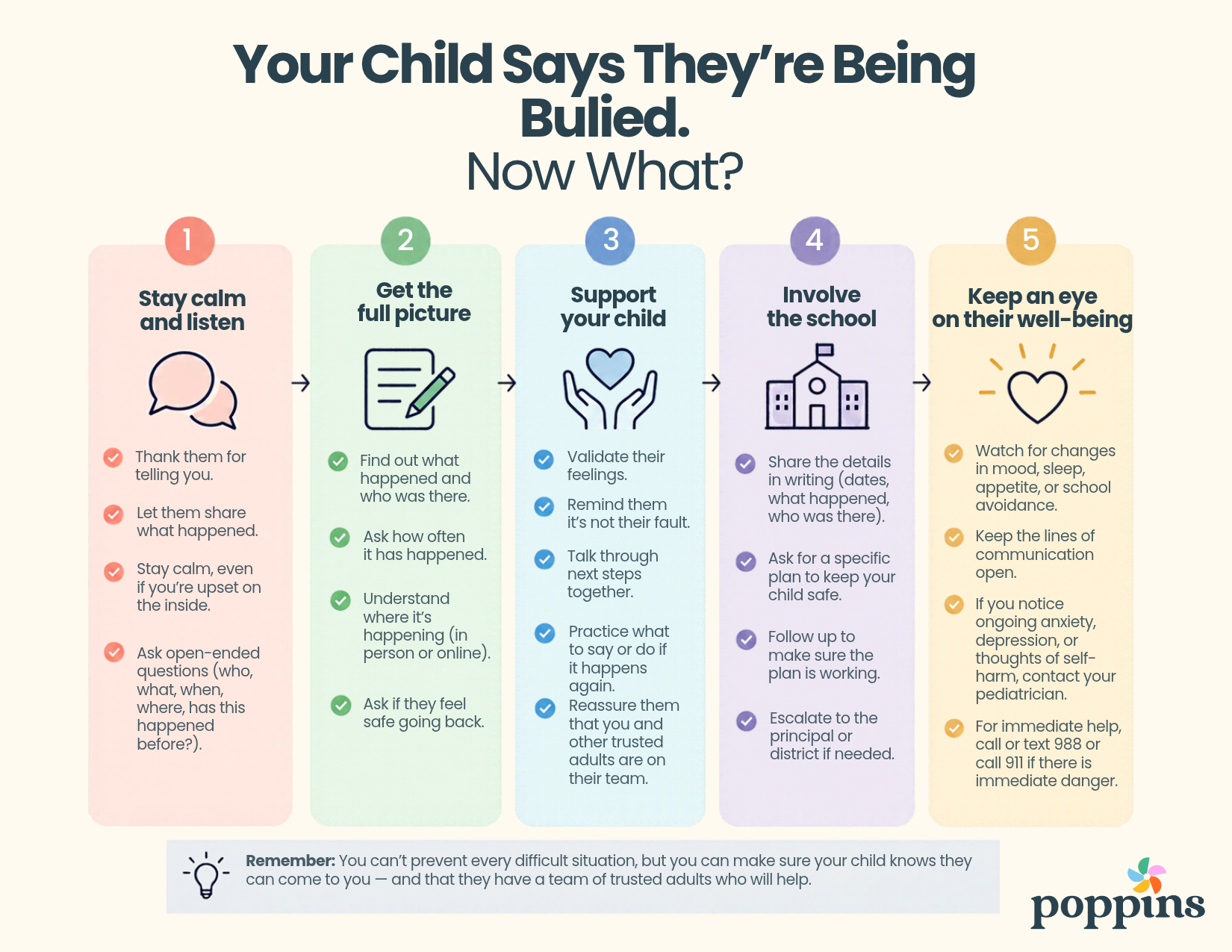
Involving the School
Even though your child may resist, it can be vital to inform the school to what has been going on.
Put it all in writing. The dates, what happened, who was there and any screenshots.
Ask for a specific plan. “Will there be changes in supervision?” “Who is going to check in with my child during the day?” “When should we all follow up together to make sure things are working?” The school will usually be unable to tell you how the other child will be punished due to privacy rules, although they can and should inform you about the steps they’ll take to keep your child safe.
Escalate when necessary. If the bullying continues, escalate to the principal and to the district. Threats, physical assault, sexual harassment, stalking or sharing sexual images of a minor go beyond typical school issues and may require law enforcement.
Cyberbullying
Pew Research found that 46% of teenagers in the United States have suffered at least one form of cyberbullying through group chats, in games, in comments, and through anonymous accounts, and these continue to follow the children at home.
Instead of telling your child to “just get off your phone,” save evidence before blocking and reporting, and walk through privacy settings and reporting tools together. Telling a child not to use their phone can feel like being told to leave their whole social world and will instead teach your child not to tell you what may be happening. Also talk about participation. Liking, forwarding, or adding a laughing emoji makes someone a part of the problem.
If Your Child Is the One Bullying
Breathe. You don’t have to consider your child to be a bad person, but you do need to take their behavior seriously. Show curiosity, “What was going on with you when that happened?” and then make it clear “I see that you were frustrated, but it’s not okay.” Set a limit, collaborate with the school and work on what your child can do next time.
A forced apology is not that same as a true repair. When children are given apologies on commend, they are learning that saying “sorry” is just a special word that puts an end to a problem. Genuine repair involves understanding how the other child felt and then taking steps to make it right. Also remember that behavior is shaped by where parental attention is directed so make it clear whenever your child is kind or includes someone else.
Vulnerable Kids and Mental Health
Certain kids are bullied more than others. According to the CDC, 47% of teens who are sexual or gender minorities were bullied over the past year as compared to 30% of their peers, and teenagers who have a developmental difference such as ADHD or autism were also bullied more. It’s easier to teach your child to be accepting of differences before any harm occurs, so have these conversations early and often in a matter-of-fact way well before problems may arise.
Teenagers who had been bullied were also twice as likely to report symptoms of anxiety or depression. If you notice that a child is sad or anxious for a week on end, refusing to go to school, experiencing major changes in sleep or eating habits, or becoming withdrawn, make sure to take action.
If your child ever says “I’m worthless” or talks about hurting themselves, don’t wait. You can call or send a text to 988, and if there’s immediate danger, you should call 911.
Final Thoughts
We can't shield our children from every mean kid or every lonely moment at lunchtime, but we can raise them to know they can come to us and to notice when someone else needs help. A child who has one reliable adult at home and another at school is in a far stronger position than one who has to face the situation all by themselves.
-Dr. Mona
TL;DR: What Parents Should Know About Bullying
- Look for repetition, harm, and a power imbalance. Playful teasing and a single mean comment should be taken seriously, but do not require a severe response.
- Kids tell parents who don't explode. Regular conversations are more effective than having one long talk.
- Practice using assertive words at home. "Stop," "That's not funny," and "Don't talk to me like that." Then practice telling an adult.
- Raise the kid who helps. Teach your child not to encourage bullying, to support others, to say something even if it's short, and to get an adult.
- Appear calm even if you're exploding on the inside. Start with "I'm glad you told me" and "Tell me what happened."
- Put it all in writing. Document the dates, what happened, who was there, and any screenshots. Ask the school for a specific plan.
- Keep an eye on patterns. Changes in mood, sleep, appetite, friendships, or school attendance may be signs that your child needs additional support.
One Question to Think About
Does your child know which two safe adults at school they can turn to if something happens?
Poppins Is Here to Help
If your child is struggling with bullying, school anxiety, or difficult friendships, you don't have to navigate it alone. Poppins Certified Parent Coaches can help you work through these conversations and determine next steps. And if you're concerned about changes in your child's mood or physical health, Poppins pediatric medical providers are here to help.
Connect with Poppins for support when you need it.