
Halloween is a perfectly normal holiday where we dress children in clothes they can barely walk in, send them outside after dark, hand them buckets of choking hazards, and tell them to knock on strangers’ doors.
Fun? Absolutely. A little chaotic? Also yes.
The good news is that Halloween safety does not require turning October 31 into a risk-management seminar. Most of the things that make Halloween safer are small: checking that the costume actually fits, putting the flashlight somewhere you can find it, moving the candle away from the front steps, and taking five minutes to sort candy before everyone dives in.
Here’s the Halloween safety roundup worth running through before the costumes go on.
Start With the Costume, Not the Candy
A costume can look incredible standing in your kitchen and become considerably less functional once your child is trying to navigate a dark sidewalk while carrying a plastic pumpkin.
Before heading out, do a quick real-world test.
Have your child walk, bend down, climb a couple of stairs, and look in every direction while wearing the whole costume — shoes, mask, cape, accessories and all.
Check for:
- Long hems, capes or skirts that could get under their feet
- Shoes they can actually walk in for more than five minutes
- Masks, hats or wigs that interfere with vision
- Long or rigid costume props that could cause an injury during a fall
- Loose, flowing material that could get too close to a candle or other heat source
- Costume labels that indicate the material is flame resistant
The American Academy of Pediatrics recommends choosing costumes that fit well, do not obstruct a child’s vision, and make children easier to see after dark. Reflective tape or other reflective material can be added to costumes and treat bags, and kids should carry a flashlight or another light source when trick-or-treating.
No, you do not need to transform Spider-Man into a highway construction worker. You just need him visible.
Face paint can also be a better option than a mask that limits peripheral vision. Use products intended for use on skin, test unfamiliar makeup on a small patch of skin ahead of time, and keep it away from the eyes unless the product specifically says it is safe for that area.
Make the Street-Safety Talk Very Short — and Very Specific
You probably do not need to deliver a lecture about pedestrian safety at 5:58 p.m. while someone is asking where their witch hat went.
Pick a few rules your child can actually remember.
For younger kids:
- Stay with the adult.
- Walk on sidewalks when available.
- Cross at corners or crosswalks rather than between parked cars.
- Stop before driveways and streets.
- Look for cars before crossing — even when other trick-or-treaters are already going.
The driveway piece deserves more attention than it gets. Drivers backing out may have poor visibility, and excited kids are very good at appearing somewhere they were not three seconds ago.
For older kids going without an adult, decide the route, group and return time before they leave. Phones should be charged, and everyone should know what to do if the group gets separated.
Halloween independence can be great. Halloween improvisation does not need to be.
“You don’t need a long list of Halloween rules that kids are going to forget the second they see the first candy bowl,” says Poppins Pediatric Nurse Practitioner Mary Clare Zak, CPNP. “A few simple things make the biggest difference: make sure they can see and walk safely in their costume, make them easy for drivers to see, and have a plan for streets, candy and allergies before you head out.”
Candy Safety Is Mostly About Choking and Allergies
There is plenty of cultural drama around Halloween candy. From a pediatric safety standpoint, two issues deserve much more attention than whether your child eats three Kit Kats instead of two: choking and food allergies.
Watch the Choking Hazards
Eating candy while walking, running and talking is not a great combination, particularly for little kids. Whenever possible, have children wait until they are sitting down to start eating their haul.
The American Academy of Pediatrics specifically recommends that babies and toddlers avoid hard candies, caramel apples, popcorn, gum, small candies, gummy candy, pumpkin seeds and foods containing whole nuts because of choking risk.
And remember that the non-candy loot can be a problem too. Candy wrappers, stickers and small novelty toys can also become choking hazards in little hands.
If you have a toddler and an older child dumping candy across the same kitchen table, do the sorting before the toddler begins their own highly efficient inspection process.
Food Allergies Require a Label Every Time
For families managing food allergies, Halloween candy needs a second look before it gets eaten.
Read the actual ingredient label on the actual piece of candy. Do not rely on what the standard-size version usually contains.
This one is especially important: fun-size or miniature candies may contain different ingredients or may be manufactured on different equipment than the regular-size version. Even if your child has safely eaten a certain brand before, check the Halloween version again.
If there is no ingredient label or you cannot confidently identify what is in a treat, skip it.
Children with prescribed emergency allergy medication should have it with them while trick-or-treating — not sitting on the kitchen counter because “we’re only going around the block.” Make sure the adults supervising know where it is and how to use it. The AAP recommends that children with food allergies carry their prescribed emergency medication, such as epinephrine, while trick-or-treating.
The Teal Pumpkin Project can also help families identify homes offering non-food treats. A teal pumpkin signals that non-food options are available for children who may not be able to safely eat traditional Halloween candy.
Give the Candy a Once-Over Before Everyone Digs In
You do not need a magnifying glass and a forensic evidence bag.
You do want to take a quick look at what came home.
The AAP recommends that parents wait until children are home to sort and check treats and throw away anything spoiled, unwrapped or suspicious.
That means tossing candy or treats that are:
- Unwrapped when they should be wrapped
- In torn, punctured or damaged packaging
- Spoiled or visibly unusual
- Homemade or unlabeled if you do not know and trust the source
- Not appropriate for your child’s age or allergy needs
Then let Halloween be Halloween.
You do not need to make your child earn every piece, “detox” from sugar the next morning, or turn the candy pile into a nutrition negotiation at 9 p.m. Decide on a reasonable family plan for enjoying the candy over the next several days and move on.
There are enough battles happening around bedtime already.
Pumpkins: Let Kids Scoop, Let Adults Carve
Pumpkin carving is one Halloween tradition where division of labor is useful.
Younger children can:
- Draw the pumpkin face
- Scoop out seeds and pulp
- Help choose the design
- Decorate the outside with paint or stickers
Adults should handle the actual cutting.
Once the masterpiece is complete, battery-operated candles or lights are the safer option for jack-o’-lanterns, especially anywhere children may be nearby.
If you do use a real candle, keep the pumpkin well away from walkways, doorsteps, curtains, decorations and anywhere a cape, sleeve, child or enthusiastic dog could knock into it.
Which brings us to another frequently overlooked Halloween safety issue: your own front porch.
Do a Trick-or-Treater Safety Sweep of Your House
Before worrying about every other house in the neighborhood, walk outside and look at yours.
Halloween means children you have never met will be navigating your property in the dark while staring at a bucket of candy instead of the ground.
Give them a fighting chance.
Before trick-or-treating starts:
- Turn on exterior lights.
- Clear toys, garden tools and other tripping hazards from lawns, steps and walkways.
- Move electrical cords away from walking paths.
- Secure decorations that could fall or blow into the path.
- Keep open flames away from steps and walkways.
- Check decorative light strands for damaged sockets, frayed wires or loose connections.
- Keep pets safely contained when the door will be opening repeatedly.
A dog who is delightful at 2 p.m. may have very different feelings about 47 masked children ringing the doorbell after dark.
Glow Sticks Are Useful. They Are Also Apparently Delicious to Children.
Glow bracelets and necklaces are great for visibility.
They are less great when someone decides to bite one open.
Fortunately, glow-stick liquid is considered non-toxic, although it can irritate the mouth, skin and eyes.
If a glow stick leaks into your child’s mouth, wipe or rinse the mouth and offer water. If it gets on the skin, wash the area with soap and water.
If glow-stick liquid gets in the eye, Poison Control recommends immediately rinsing the eye with running water for 15 minutes.
And if you are not sure what to do after an exposure, Poison Control is available at 1-800-222-1222.
The easiest prevention strategy is also the obvious one: remind kids that glow sticks belong on wrists, necks and treat bags — not between their teeth.
Halloween Decorations Need a Toddler-Eye View
If you have a baby or toddler, get physically lower and look around before the Halloween party starts.
That bowl of decorative plastic spiders? Mouth-sized.
The battery compartment in the light-up pumpkin? Worth checking.
The extension cord tucked behind the table? Suddenly fascinating.
The fake cobweb stretched across the banister? Apparently something someone urgently needs to pull.
Keep small decorations, loose batteries, breakable items and accessible cords out of reach. Make sure battery compartments on light-up decorations and toys are securely closed, particularly when they contain button or coin batteries.
Halloween décor gets treated like temporary clutter, which is exactly why it can escape the usual childproofing radar.
Make Halloween Work for the Kid You Actually Have
Safety is not only about avoiding physical injury.
Halloween can involve loud decorations, flashing lights, unfamiliar faces, masks, crowds, unpredictable noises and a bedtime routine that has completely left the building.
For some kids, that is thrilling. For others, it is a lot.
If your child tends to become overwhelmed:
- Try the costume at home before Halloween.
- Let them skip masks, hats or accessories they cannot tolerate.
- Bring hearing protection if noise is difficult for them.
- Start earlier when crowds may be smaller.
- Decide ahead of time what “done” looks like.
- Give them permission to stop.
Four houses and a happy kid is a successful Halloween.
So is staying home and handing out candy.
There is no minimum trick-or-treating requirement for childhood.
The 60-Second Safety Check Before You Leave
When everyone is finally dressed and someone is already standing by the door, run through this:
Costume: Can they see, walk and climb stairs?
Visibility: Do they have something reflective, illuminated or bright?
Route: Does everyone know where they are going and who they are staying with?
Allergies: Is prescribed emergency medication packed, if needed?
Phone: Is it charged for older kids going independently?
House: Are candles, decorations, pets and walkways secure?
Candy rule: Does everyone know treats get checked before eating?
That is enough.
Halloween does not need a 37-point safety protocol. It needs a handful of smart decisions made before everyone is three blocks away from home.
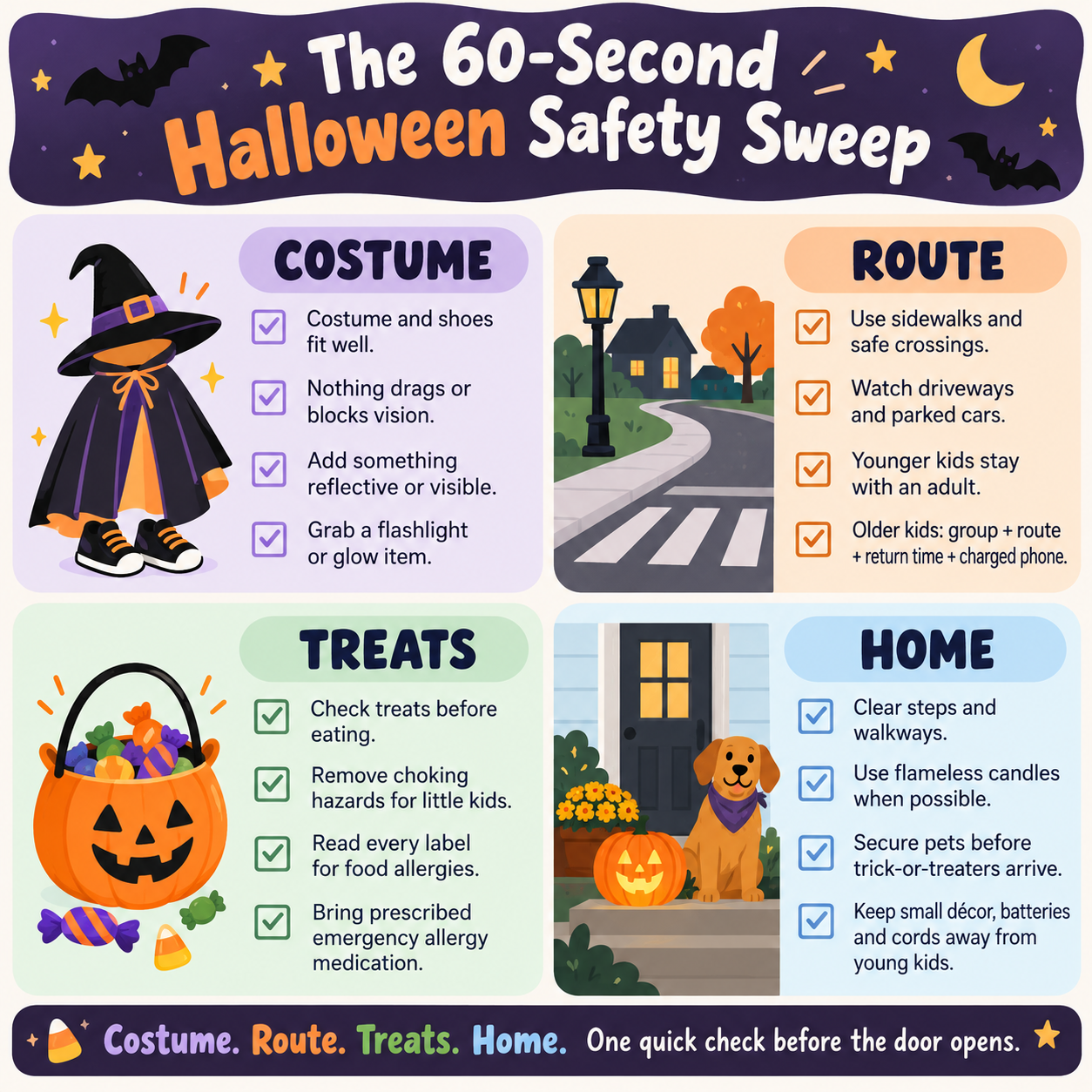
TL;DR: Your Halloween Safety Roundup
- Make sure costumes fit, kids can see clearly, and shoes can handle actual walking.
- Use flashlights, glow items or reflective materials so kids are easier to see after dark.
- Keep street rules simple: sidewalks, safe crossings, driveway awareness and no darting between cars.
- For little kids, remove choking hazards before the candy free-for-all begins.
- For food allergies, read the label on every treat and bring prescribed emergency medication.
- Let adults carve pumpkins and use flameless lighting whenever possible.
- Clear your own walkway, secure pets and keep candles away from trick-or-treaters.
- Keep small décor, accessible batteries and cords away from babies and toddlers.
- Let kids opt out, modify costumes or head home when Halloween becomes too much.
A little preparation gives kids room to do what they are supposed to do on Halloween: wear something ridiculous, collect an unreasonable quantity of candy and have fun.
And if a Halloween health question does come up — from a rash after face paint to an allergy concern, a fall or a child who simply does not seem quite right — the Poppins pediatric medical team is here to help you figure out what needs care, what can be managed at home and what to do next.
Before the costumes go on, what is the one Halloween safety check your family still needs to make?