Breastfeeding Comes With Questions. You Don’t Have to Figure Them Out Alone

Breastfeeding questions rarely show up when you have time to deal with them. They show up when your baby has been nursing for 45 minutes and you were supposed to leave ten minutes ago. Or when childcare reports another refused bottle at pickup.
August is National Breastfeeding Month, so the Poppins medical team is answering five of the questions parents ask most often about breastfeeding. Rather than giving you five versions of “every baby is different,” we’re getting specific about milk intake, feeding frequency, pain, bottles, and weaning.
There isn’t one right way to feed your baby, and there is no prize for pushing through a feeding plan that is not working. There are signs to watch for, practical adjustments to try, and situations that need more than an internet search. Here’s what to know, what to do next, and when to bring Poppins into the conversation.
1. Is my baby getting enough milk?
When nursing, you can’t track ounces the way you can with a bottle, which makes “Is my baby getting enough?” one of the hardest—and most common—questions breastfeeding parents ask. Rather than judging one feed on its own, it’s important to look at the bigger picture. Key signs that your baby is getting enough milk include swallowing during feeds, seeming satisfied afterward, age-appropriate diaper output, and steady weight gain.
During a feed: At the beginning, you may see quick sucks as your baby triggers the milk to let down. Once milk begins flowing, the rhythm should change: suck, swallow, breathe, repeat. The sucks become slower and deeper, with a short pause for swallowing before your baby takes another breath. As the feed winds down, swallowing usually becomes less frequent, and your baby’s hands, arms, and body may relax.
After and between feeds: A baby who is feeding effectively will usually seem satisfied after at least some feeds—not every feed, because babies do occasionally request another course immediately. They should also be alert when awake and have the expected number of wet and dirty diapers for their age. Those expectations change almost daily during the first week. By about day five, most babies should have at least six wet diapers in 24 hours. Stool patterns can vary more, especially as babies get older. If you’re unsure what the count should be for your baby today, the Poppins medical team can help you make sense of it.
Over time: Weight gain gives the clearest picture of whether your baby is taking in enough milk. Many newborns return to their birth weight by about 10 to 14 days. One weigh-in does not tell the whole story; it’s important to review the trend alongside feeding frequency, swallowing, and diaper output.
Until birth weight is regained, babies generally need to feed at least every three hours, even if that means waking them. Babies who were born early, have jaundice, tire during feeds, or are gaining slowly may need a more individualized feeding schedule.
If your baby needs additional milk while breastfeeding gets back on track, supplementation may be part of the plan. A supplement can be expressed breast milk or infant formula, and supplementing does not mean breastfeeding is over. If maintaining milk supply is the goal, nursing, hand expressing, or pumping when a supplement is given helps signal your body to keep producing milk.
2. How often should my baby breastfeed?
Newborns typically breastfeed 8 to 12 times in 24 hours. That sounds almost orderly until several of those feeds happen back-to-back during the exact window when you planned to eat dinner, answer one email, or sleep.
Frequent feeding does not automatically mean your milk supply is low. Newborn stomachs are small, breast milk digests quickly, and babies often cluster feed during growth spurts or in the evening. Instead of trying to force a perfect schedule, watch for early hunger cues: stirring, bringing hands to the mouth, rooting, or smacking the lips. Crying is a later cue, and a very hungry, very angry baby is generally less interested in collaborating on a good latch.
Until your baby has regained their birth weight, offer a feed at least every three hours—even if you need to wake them. Once they are back to birth weight and gaining appropriately, feeding can usually shift to on demand, including overnight. Offering feeds every three to four hours during the day can help establish a workable rhythm, but offer; don’t force.
The length of a feed matters less than what your baby is doing during it. Let your baby continue on the first breast while they are actively sucking and swallowing, then offer the second. Some babies want both sides. Others finish one side and decline the second with the confidence of someone who has never had to worry about wasting food.
If your baby regularly falls asleep before actively swallowing, try feeding skin-to-skin, undressing them to the diaper, gently rubbing their hands or feet, or switching sides. A baby who repeatedly tires during feeds or needs constant stimulation to keep eating may need a closer assessment.
3. Is breastfeeding supposed to hurt?
Breastfeeding can feel unfamiliar and intense at first. Persistent pain, however, is not something you are supposed to endure until your nipples “get used to it.”
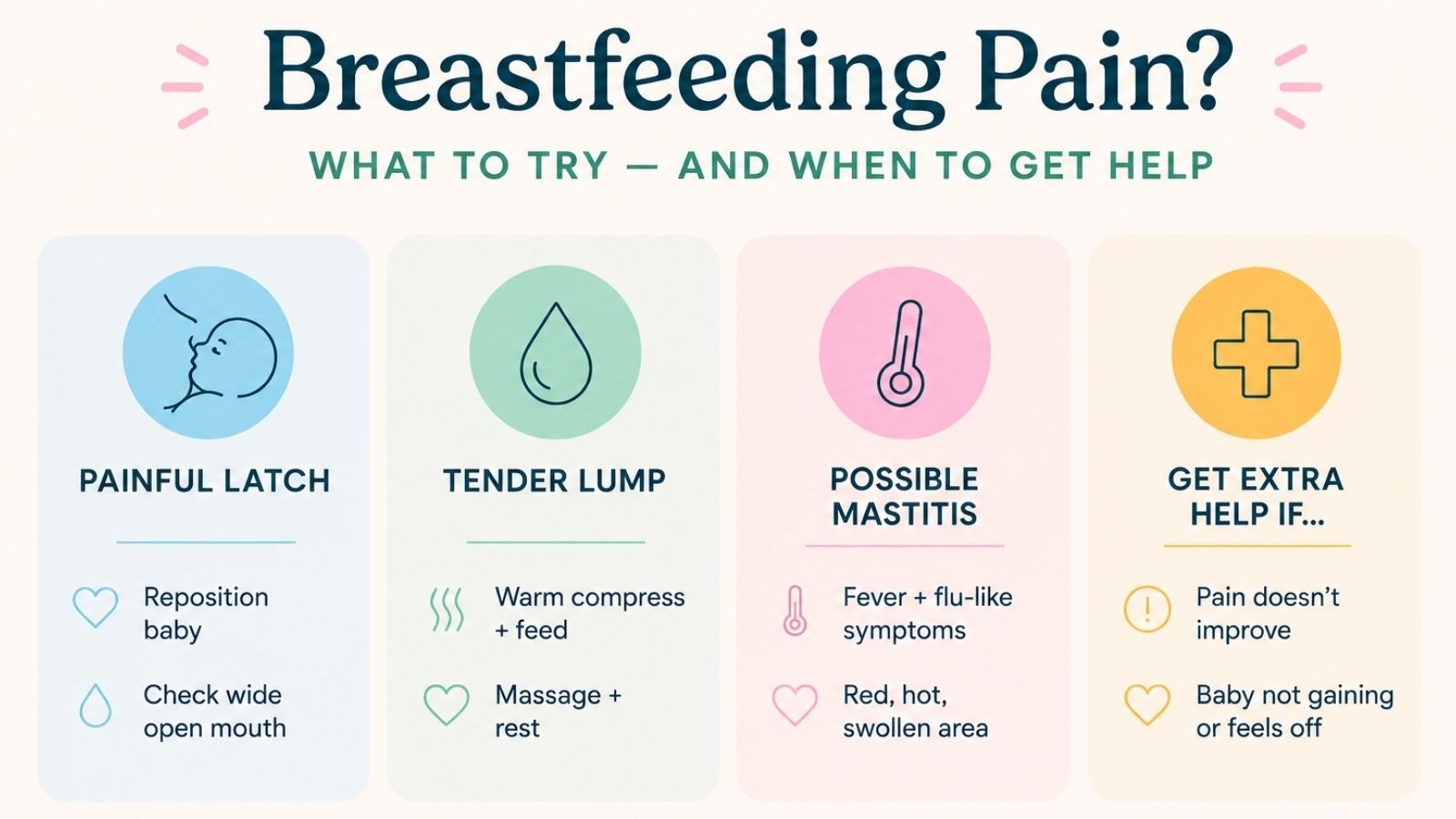
A good latch usually feels like tugging or pressure—not pinching, biting, or burning. Your baby’s mouth should open wide around the breast, with the lips turned outward and the chin resting against the breast. You should see deep jaw movements and hear regular swallowing once your milk begins flowing. Clicking or smacking sounds, cheeks that dimple inward, repeatedly slipping off the breast, or a nipple that looks flattened or creased after a feed can all suggest that the latch is too shallow or your baby is losing suction.
If the latch hurts, gently break the suction with a clean finger and try again. It may feel easier to tolerate a painful latch than restart a feed when you are already late, but letting the same shallow latch continue can leave you with cracked nipples and an even bigger problem at the next feeding.
Soreness should improve quickly when the latch and positioning improve. Cracks, bleeding, blisters, burning pain, or discomfort that continues despite a deeper latch should be evaluated.
What if I have a painful lump or think I have mastitis?
A tender lump or firm area is often caused by inflammation and swelling that narrow the ducts carrying milk through the breast. This is commonly called a “clogged duct,” but it is not a solid plug that needs to be forced out. Squeezing the area, using deep massage, or pumping more than your baby needs can increase inflammation and injure the breast tissue.
Continue nursing or pumping according to your baby’s usual feeding pattern. If it is comfortable, you can start on the affected side, but do not repeatedly empty the breast in an effort to clear the lump. Use a cold compress for 10 to 15 minutes after or between feeds, and consider ibuprofen or acetaminophen if you can take them safely. Gentle breast movements may help with swelling, but massage should remain light. A brief warm compress before feeding may help trigger letdown; prolonged heat will not “melt” the lump and may make swelling worse.
A localized lump without fever or flu-like symptoms may improve with these steps. Mastitis is different and may cause an increasingly red, hot, and painful area of the breast along with fever, chills, body aches, or feeling generally sick. Contact your OB-GYN or primary care provider if you develop worsening redness or pain, flu-like symptoms, or a fever above 101°F. If symptoms are not improving within 24 to 48 hours—or you feel severely ill—you need an in-person assessment and may need antibiotics.
4. How can I prepare my breastfed baby to take a bottle?
Your return-to-work date is not the ideal time to discover that your baby considers bottles a personal insult. If breastfeeding is going well and you know your baby will need to take a bottle, consider introducing one around two to four weeks rather than waiting until the first day of childcare.
Start with a small amount of expressed milk once a day. Once your baby accepts the bottle, continue offering one at least every few days so the skill stays familiar. It does not need to become another major task on the schedule; the goal is practice, not a nightly performance review.
Use a slow-flow nipple and paced feeding to make the experience feel more like nursing:
- Hold your baby semi-upright or in a supported side-lying position.
- Keep the bottle mostly horizontal so the milk does not pour into their mouth.
- Pause every 30 to 60 seconds and watch for fullness cues.
- Let your baby decide when they are finished rather than encouraging them to empty the bottle.
If your baby refuses, try having another caregiver offer the bottle while you are out of sight. Experiment with the temperature of the milk, the feeding position, or the nipple—but resist buying every bottle on the internet after one bad attempt. Babies often need repeated, low-pressure practice.
Pumping will also become part of the equation if you want to provide expressed milk and maintain your supply while you are apart. In general, pumping around the times your baby receives bottles helps your body continue producing the milk your baby needs. Poppins can help you think through bottle practice, paced feeding, and a realistic feeding routine before the childcare handoff is suddenly tomorrow.
5. How—and when—should I wean?
There is no required age or single correct reason to wean. You may want to stop pumping at work, keep only morning and bedtime feeds, end overnight nursing, or finish breastfeeding completely. Start by deciding what you want to change rather than assuming weaning has to mean stopping everything at once. As Mary Clare Zak, CPNP, a pediatric nurse practitioner at Poppins, explains, “Weaning does not have to be all or nothing. The first step is deciding whether you want to drop one feed, stop pumping, night wean, or fully wean—then building the plan around that specific goal.”
Gradual weaning tends to be easier on both your body and your child. Drop one feed at a time, then wait about three to seven days before dropping another. If you have an oversupply or a history of clogged ducts or mastitis, go more slowly. Begin with the feed your child seems least attached to and save the most comforting feed—often morning or bedtime—for later.
What replaces the feed depends on your child’s age:
Younger than 12 months: Replace the feed with expressed breast milk or iron-fortified infant formula. Solid foods should not replace your baby’s primary milk source yet.
12 months or older: Offer an age-appropriate milk beverage in a cup alongside a regular pattern of meals and snacks. Because plant-based beverages are not nutritionally interchangeable, check with the Poppins medical team about the best option for your child.
If your breasts become uncomfortably full, express only enough milk to soften them rather than fully emptying them. Cold packs, a supportive but not tight bra, and ibuprofen or acetaminophen—when safe for you—can help with discomfort.
For a toddler, changing the routine often works better than repeatedly saying no. Offer a snack after childcare instead of sitting in the usual nursing chair. Move nursing to one predictable time or place. Try “We’ll nurse after your bath” rather than “Not now,” then replace the former feed with a book, song, or cuddle. If you are night weaning, another caregiver may need to handle some wake-ups while everyone adjusts.
Expect each change to take several days. Illness, travel, or a childcare transition may be a good reason to pause rather than force the timeline. Weaning is not a test of resolve any more than breastfeeding is. It is a transition, and you are allowed to make a plan that works for both of you.
You don’t need to solve every feeding question alone
Breastfeeding changes as quickly as your baby does. The routine that worked during leave may feel very different once pumping enters the workday. The bottle your baby accepted last week may be rejected at childcare today. And the feed you once worked hard to establish may eventually become the one you are ready to drop.
That does not mean you are doing it wrong. Feeding needs can shift, and you are allowed to reconsider what is working without defending the decision.
The useful question is not whether you are breastfeeding the “right” way. It is whether your baby is growing and getting enough milk, feeding feels physically manageable, and the routine works for you, too. Nursing, pumping, supplementing, formula, combination feeding, and weaning can all be part of a healthy feeding plan—and that plan is allowed to change as you and your baby do.
TL;DR
Most newborns breastfeed 8 to 12 times in 24 hours. Because you cannot measure ounces at the breast, look at milk transfer, diaper output, and weight gain together. Breastfeeding should feel like tugging or pressure—not persistent pinching, burning, or pain. Introduce a bottle around two to four weeks if your baby will need one, and keep offering it regularly. When you are ready to wean, make one change at a time and give your body and your child several days to adjust. Supplementing, pumping, combination feeding, and partial weaning are all valid parts of a breastfeeding plan.
What part of feeding feels hardest to figure out right now: whether your baby is getting enough, making feeds more comfortable, preparing for bottles, or deciding what you want weaning to look like?
For questions about feeding frequency, diaper output, bottle feeding, milk replacement, or your baby’s nutrition, message the Poppins medical team for personalized guidance. If the challenge is fitting feeding or weaning around childcare, sleep, work, and the rest of family life, a Poppins coach can help you create a routine that feels realistic and sustainable.