Parenting Without Yelling: What to Do Before and After You Lose Your Cool

Last night, after the kids were finally asleep and the house was quiet, you made yourself a promise. Tomorrow will be different. You'll be more patient, listen more, react less, and stay calm even when things don't go as planned. No yelling. No losing your cool over the little things. And you meant every word of it.
Then morning arrives. Someone can't find their shoes. Your child suddenly decides they don't like the breakfast they've been eating all week. You've got lunches to pack, a meeting to get to, and a clock that seems to be moving much faster than everyone else in the house. You ask nicely, offer reminders, and try again. But as the minutes tick by, you can feel that familiar frustration building. Before you know it, you're yelling.
Maybe everyone finally starts moving, and you even make it out the door on time. But something doesn't feel right. You catch the look on your child's face, or perhaps it's the unusual silence in the car on the way to school. And there comes that familiar feeling again. I promised myself I wouldn't yell today. Why did I do it again?
For some parents, raising their voice feels like the only way to get their children to listen. For others, it's a response they desperately want to change but struggle to control in the heat of the moment. Either way, simply promising yourself to be more patient rarely works. To change the pattern, we need to understand what leads to yelling, what we can do differently in those difficult moments, and how to take responsibility when we don't respond the way we intended.
Why Do We Yell at Our Kids Even When We Don't Want To?
Yelling rarely begins with the missing shoe, spilled milk, or child who refuses to get out of the bathtub. Those are often just the moments when everything we've been carrying finally spills over.
Think of an iceberg. What we see above the surface is the yelling, but underneath may be exhaustion, stress, unrealistic expectations, feeling unheard, or the pressure of keeping everything running. Sometimes there are patterns we learned long before becoming parents. If you grew up in a home where adults raised their voices to get children to listen, yelling may feel like a familiar response, even if it's one you've promised yourself you wouldn't repeat.
Our interpretation of our child's behavior can also make a difficult moment more intense. When you've asked your child to put on their shoes five times, it's easy to think, They're ignoring me. They know we're late. Why won't they just listen? But what looks like defiance may sometimes be a child struggling to shift attention, manage a transition, or stop doing something they enjoy.
That doesn't mean children don't need boundaries or accountability. They absolutely do. It simply means that understanding what's underneath a behavior can help us respond more effectively. And the same curiosity applies to us. Instead of asking, What's wrong with me? Why can't I stay calm? we can begin asking, What's happening inside me right before I yell?
That's where meaningful change begins.
What Happens When We're Overwhelmed?
When stress builds, our bodies can shift into a heightened state of alertness. Our hearts may race, our muscles tighten, and it can become harder to pause, think flexibly, and choose a thoughtful response. Suddenly, a child refusing to put on shoes can feel much bigger than it really is.
Our emotional states can also influence one another. A 2014 study published in Psychological Science found that infants' physiological responses were influenced by their mothers' stress after they were reunited. Similarly, a 2019 study published in Social Development examined parent-child interactions during an emotionally challenging task and found evidence that parents' physiological responses influenced aspects of their children's responses.
These findings help us understand how closely connected parents and children can be. They don't mean children automatically mirror every emotion we experience, or that a calm parent will always produce a calm child. But they remind us that how we show up matters.
According to Jahanvi Shah, Poppins Certified Parent Coach, “Calm is contagious. But the greatest gift we give our children isn't to never lose our cool. It's showing them that even when emotions run high, we can pause, choose connection over reaction, and find our way back to each other.”
We often ask our children to take a breath, use their words, and manage their frustration. Yet many of us were never taught how to do those things ourselves. Now we're learning those skills while trying to teach them to our children. That takes awareness, practice, and compassion. The encouraging part is that we don't have to master emotional regulation before we begin modeling it. Even saying, "I'm feeling frustrated. I'm going to take a moment before I respond," shows a child what it looks like to recognize an emotion without allowing it to dictate our behavior.
These everyday interactions matter. Harvard University's Center on the Developing Child emphasizes the importance of responsive, back-and-forth interactions in supporting children's development. The way we respond to our children, especially during difficult moments, gives us opportunities to nurture both connection and emotional growth.
How to Stop Yelling Before It Starts
Changing the yelling pattern begins before the words come out of our mouths. Often, the first step has less to do with what our child is doing and more to do with what we're noticing inside ourselves.
1. Notice and Acknowledge What's Happening Inside You
Our bodies often give us clues before we lose our cool. Maybe your jaw tightens, your shoulders rise, your voice becomes sharper, or you feel that familiar rush of heat and urgency. Instead of pushing through those signals, try pausing long enough to notice them.
You might place a hand over your heart and say, even out loud, "I'm feeling overwhelmed right now. I need a moment."
That acknowledgment matters because emotions aren't the enemy. They're information. Frustration may be telling us we're overloaded, running out of time, or expecting more than we or our child can manage in that moment. The goal isn't to stop feeling frustrated. It's to recognize the feeling before it starts making decisions for us.
2. Give Yourself a Moment to Choose Your Response
When we're overwhelmed, everything can feel urgent. But in an ordinary, safe parenting moment, not every disagreement needs an immediate reaction. Try slowing your breathing, relaxing your shoulders, or grounding yourself with a gentle reminder: This is a difficult moment, not an emergency. My child and I can get through this. I don't have to figure everything out right now.
Sometimes that pause is only a few seconds. Other times, if your child is safe, you may need to step away briefly and return. You're not ignoring the behavior or giving up your authority. You're creating enough space to respond with intention instead of reacting from frustration.
3. Get Curious, Not Furious
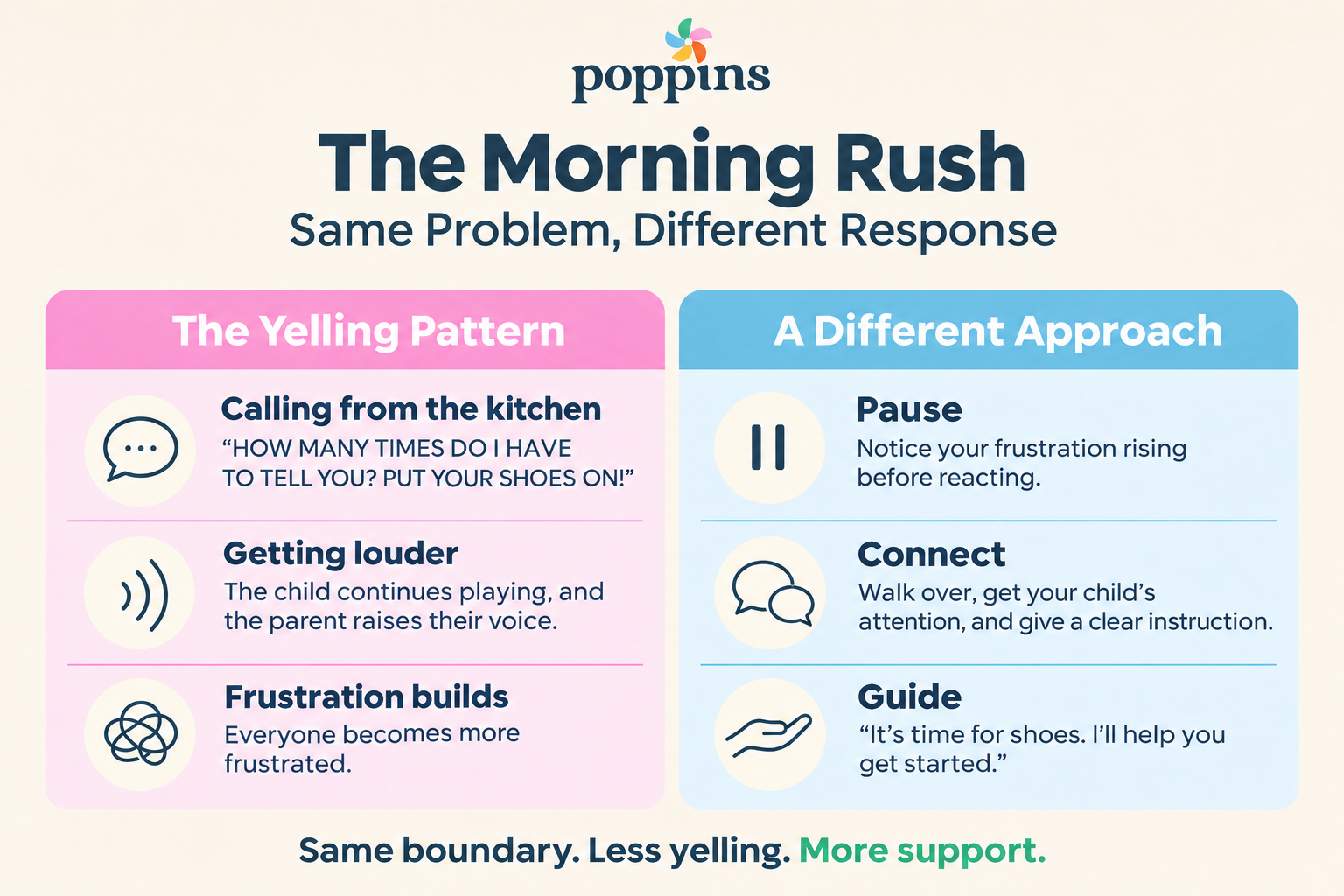
Picture yourself in the kitchen, calling upstairs for the fifth time, "PUT YOUR SHOES ON! WE'RE LEAVING!" From your perspective, you've already given plenty of reminders. But your child may be deeply absorbed in building something, reading, or playing. They may have heard you and still be struggling to shift their attention.
Instead of increasing your volume, try changing your approach. Walk over, get down to your child's eye level, say their name, and, if they welcome touch, gently place a hand on their shoulder. Then offer one short, clear instruction: "It's time to leave. Let's finish what you're doing and put on your shoes. I'll help you get started."
You're still communicating the expectation, but you're also helping your child move toward it. This doesn't guarantee immediate cooperation, of course, but it gives children a better opportunity to respond than repeated instructions shouted from another room.
What If Your Child Still Won't Listen?
Here's where parents sometimes get stuck. If I stay calm and my child still refuses, then what?
Staying calm doesn't mean becoming permissive, and connecting with your child doesn't mean giving up the boundary. We can be both understanding and firm. In fact, the American Academy of Pediatrics, in its policy statement on effective discipline, recommends positive discipline strategies and advises against harsh verbal discipline, including yelling and shaming.
Let's say your child is having the time of their life in the bathtub, but it's time to get ready for bed. Instead of shouting, "That's it! Get out right now!" you might say, "You're having so much fun. It's hard to stop when you're enjoying yourself, isn't it? And it's time to get out. Would you like to hop out like a bunny, or should I wrap you up like a burrito in your towel?"
Your child might still protest. They might even cry. That's okay. Our job isn't to make every boundary feel good. It's to hold the boundary while helping our child through the feelings that come with it. We can acknowledge disappointment without changing the expectation, and sometimes, especially with younger children, they need our help moving through a transition rather than another explanation.
What If You've Already Yelled? How to Repair With Your Child
Now let's return to that morning when you promised yourself you wouldn't yell. You were running late, your frustration took over, and you raised your voice. Afterward, you noticed the hurt on your child's face. What happens next matters.
In relationships, there will be moments of disconnection, sometimes called ruptures. Repair is the process of acknowledging what happened, taking responsibility, and working to rebuild connection. But there's an important distinction here: repair is not permission to keep yelling. An apology doesn't erase the impact of repeated hurtful behavior. Meaningful repair includes a genuine commitment to changing the pattern, not simply saying sorry each time it happens.
When we approach repair with sincerity, we're also modeling something powerful for our children: what it looks like to acknowledge a mistake, take responsibility, and make an effort to do better.
1. Settle Yourself Before Reconnecting
If you're still feeling angry or overwhelmed, give yourself a little time to settle before approaching your child. You don't have to be perfectly calm, but you do want to be able to listen without becoming defensive. Sometimes a few quiet moments can help you approach the conversation with greater openness.
2. Take Responsibility Without Blaming Your Child
You might say, "I'm sorry I yelled at you this morning. I was feeling frustrated and rushed, but yelling wasn't okay. I'm working on handling those moments differently."
Notice what's missing? There's no "but you weren't listening." Your child may need to work on listening or following instructions, but that's a separate conversation. We can hold children accountable for their behavior without making them responsible for ours.
3. Make Room for Your Child's Feelings
Your child may want a hug, they may want to talk, or they may not be ready to reconnect right away. You can gently ask, "How did you feel when I yelled?" and then give them space to respond.
Try to listen without explaining, justifying, or rushing them toward forgiveness. You can acknowledge their experience without asking them to make you feel better. Repair is about rebuilding trust and connection, not making our own guilt disappear as quickly as possible.
4. Talk About What You'll Do Differently Next Time
Repair becomes more meaningful when it's followed by action. You might say, "Tomorrow morning, I'm going to try coming over to you instead of calling from the kitchen. And we'll make sure your shoes are ready before breakfast."
You can also talk together about what might make mornings easier. The expectation to get ready for school hasn't disappeared, but you're showing your child that you're willing to take responsibility for your part and work toward a better way. If yelling has become a frequent pattern, that's a sign to seek more support and make an intentional plan for change.
You Don't Have to Get It Right Every Time
Parenting without yelling isn't about becoming a parent who never feels angry, frustrated, or overwhelmed. It's about learning to recognize those emotions, understand what they're telling us, and make more intentional choices about how we respond.
Some days, that might mean catching yourself before raising your voice. Other days, it might mean adjusting your expectations, asking for help, or creating a less stressful routine. And on the days you don't respond the way you hoped, it means taking responsibility, repairing the connection, and continuing to practice.
The goal isn't perfection. It's progress that your child can experience, not just promises they hear.
At Poppins, our parent coaches help families look beneath challenging behaviors, understand their own reactions, and build practical strategies that work in real life. If yelling has become a pattern you're struggling to change, you don't have to figure it out alone. Connect with a Poppins parent coach for personalized support.
TL;DR: Yelling often happens when stress, expectations, and challenging moments collide. To change the pattern, start by noticing your own signals of overwhelm, pause before responding, and help your child through transitions with clear instructions and firm, compassionate boundaries. If you do yell, take responsibility, listen to your child's feelings, and follow your apology with meaningful change. Repair matters, but preventing repeated hurt matters just as much.
A question to reflect on: The next time you feel yourself getting ready to yell, what's one small thing you could do differently before your frustration takes over?