Daylight Saving Time With Kids: How to Adjust Sleep and Routines

Time changes often act as disruption to children’s routines. With some preplanning and incremental adjustments to the schedules, parents can help children transition to the new time change more smoothly.
You’re not alone if you dread those special Sundays in November and March, marked on the calendar with the letters DST (Daylight Savings Time). Daylight Savings Time may only be a one-hour adjustment to the clock, but every parent, teacher, and caregiver knows that the days following it are r o u g h. It doesn’t matter if the 60 minutes are “lost” or “gained”, a child’s circadian rhythm is scrambled in all directions when we place new times on familiar patterns. However, with a bit of foresight-- and some Poppins parent coaching guidance-- we can minimize the impacts Daylight Savings time-change has on children.
Why Time Changes Can Be Hard for Children
Your instinct might be to just go about business as usual, assuming that your child will eventually catch up to the new time. This is, most often, what we have to do as adults; we go to bed one night, drag ourselves through the next few days, remarking about how it doesn’t feel like 3:00 or commenting on the level (or lack thereof) of daylight. But, within a week we’ve moved on to accept the new time as part of our routine.
Children are much more sensitive to shifts in their routines, though, because their bodies crave stability and consistency. In addition, the concept of losing and gaining time is incredibly abstract. Regardless of the age of your child, this confusing concept, combined with your request to go to sleep when the light feels different from usual, will likely be met with resistance.
If you’d rather not resign yourself, and your child, to a week of doom, gloom, and exhaustive behaviors in the days following the time shift, keep reading. We’ve put together a few suggestions for handling these twice-a-year clock changes to help your family feel light years ahead of DST.
Numerous studies have proven that children do so much better with advance micro-adjustments made to their schedule, especially children who are highly sensitive to change. In the book, Beyond Behaviors, Dr. Mona Delahooke explains how a lack of communication and preparation can send children into dysregulation, regardless of it being perceived as a positive or neutral event by adults. Change equals unpredictability and when people feel uncertain, or lost, behaviors erupt. Best-practice coaching always includes empathy and this situation is no exception. Understanding that stability, routine, and predictability are as comforting to children as their favorite stuffed animal or blanket is an important first layer to supporting children through a time-change disruption. By reminding yourself that their behavior is a symptom of their experiences and an extension of their survival instincts, you can react in a more positive and proactive manner. It’s empowering to help your children adapt to these new schedules, rather than just wait for them to accept it with reluctance.
How to Prepare Kids for Daylight Saving Time
Here’s a supportive approach with a few practical ideas for preparing yourself and your family for a Daylight Savings Time change:
Move Meal Time
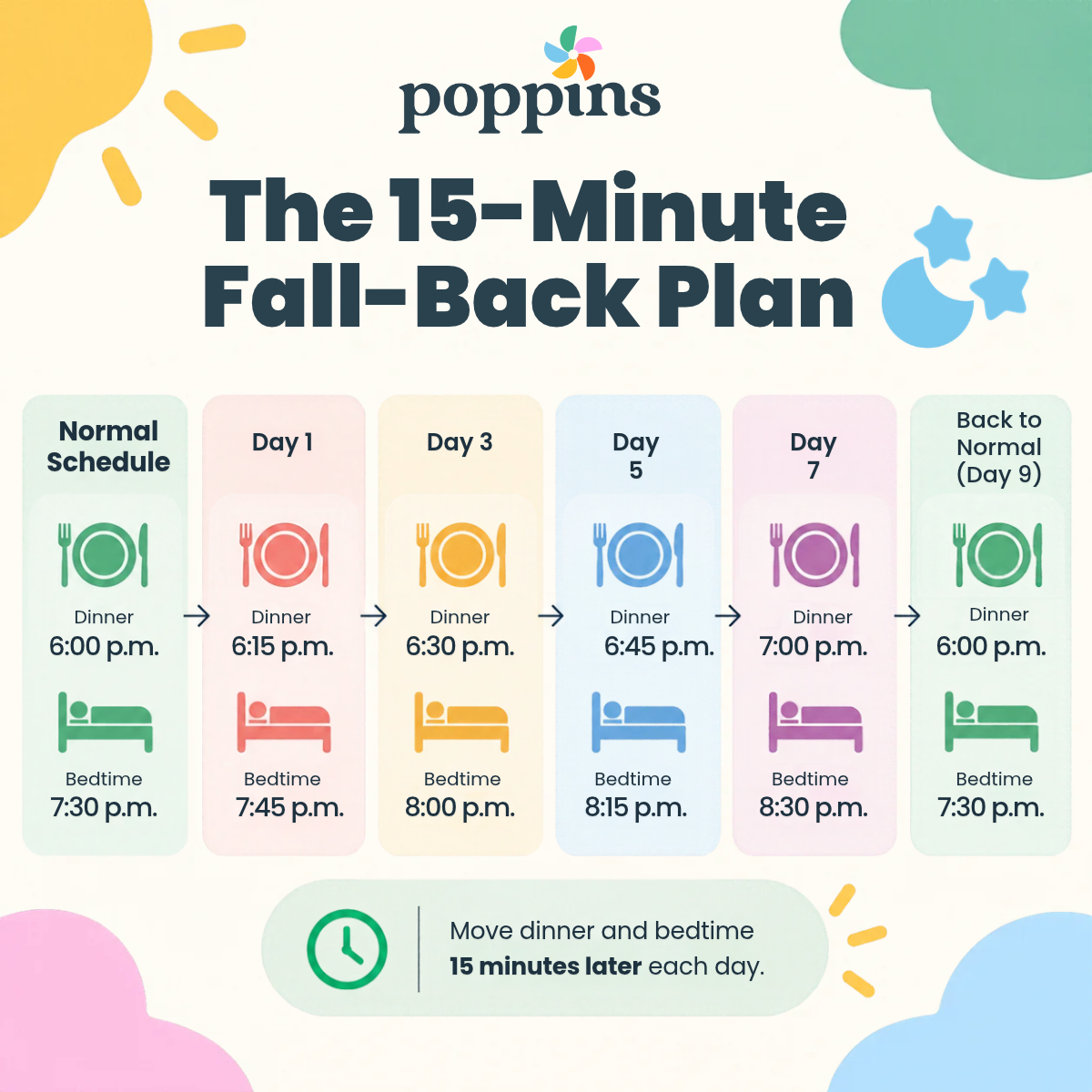
Starting about one week prior to the actual time change, adjust your dinner time. Move dinner backward or forward by 15 minutes, every few days. By attempting to stretch the time between meals, we push off the hangry feelings/actions that result from having to wait for a full hour to eat. These small, daily shifts camouflage the perceived unpredictability.
Coaching Tip: move dinner time in the opposite direction of the time change. In November, our clocks “fall back”. This results in us gaining an hour, so dinner time gets moved ahead incrementally. We lose an hour when we “spring forward” so dinner time adjustments will be in 15-minute increments backwards.
Another way to look at it: when we gain an hour, we adjust dinner forward and when we lose an hour, we adjust to an earlier dinnertime.
Sunlight = ZZZZ’s
Get outside, especially on days you’re making sleep schedule changes. Exposure to sunlight, in addition to exercise, makes falling asleep a more natural process for our bodies.
Minimize Electronics
Reduce screen and electronic time, especially in the evening hours.
Slowly Shift Bedtimes
Just like you did with dinner, move the schedule in 15-minute blocks to accommodate earlier bed times. At least one week before the time change, start going to bed 15 minutes earlier/later, following the same guidelines (ahead in the fall, back in the spring). Every other night, add another 15 minutes to the time. By starting this process 8-10 days in advance, you’ll be setting your family up for a much smoother response to DST.
In Simplicity Parenting, Kim John Payne explains a study that demonstrates how just one hour of sleep deprivation results in an academic difference of two grade levels. In other words, a loss of one hour of sleep means a fifth grader may learn, react, and behave like a third grader. Setting up a bedtime transition plan accordingly will help them from missing out on these important, brain-developing, hours.
Coaching Note: You may be tempted to ignore or skip this suggestion for yourself. We often understand the importance of our kids getting enough sleep because it helps their growing brains and bodies, but we fail to accept the importance of adequate sleep for ourselves. Sleep is one of the most important resources. Proper amounts of sleep help us fend of illness, allow us to react with more patience and thoughtfulness. The Center for Wellness and Health Promotion at Harvard talks about sleep being critical for our survival. Adjusting your sleep schedule also demonstrates and models to your children the very thing you’re asking of them; not just going to bed at an earlier time, but taking care of their bodies.
What If You Cannot Prepare for Every Change?
Preventative strategies are always the preferred route when considering how to handle an upcoming change. The earlier you start this transition process, the easier time your children will have adjusting. However, even if you can only manage to move bedtime by 30 minutes on the night of the time change, it’s still a step in reducing the overwhelm that can be caused by the one hour change.
We understand that real life happens. Sometimes the best laid plans get deterred. So, what if you can’t implement all the suggestions?
Truthfully, most of the consequences and fallout behaviors from DST show up as sleep/bedtime issues. If you can only prioritize one of these suggestions, consider the bedtime support to be the most significant. You’ll likely have the most impact by shifting the sleep schedule. Sleep is necessary and critical for growth and development and softly altering the schedule will help children’s bodies buffer the time difference.
Get Support From Poppins Parent Coaching
Want more suggestions around the topic of sleep? Check out our articles on bedtime boundaries here. Want one-on-one sleep coaching support? Book an appointment with our sleep consultant, Jenn. Our parent coaches are here to help you find more effective ways to communicate and connect with your children. Join our coaching membership and book an appointment with one of our parent coaches today!
TL;DR: Daylight Saving Time With Kids
Begin small, 15-minute adjustments to dinner and bedtime before the clock change.
Prioritize daylight and outdoor activity while limiting evening electronics.
If you can only adjust one part of the routine, focus on bedtime.
Even a partial adjustment can help; you do not need a perfect plan.
Closing reflection: Which part of your child’s routine is most likely to need extra support when the clocks change?