How to Talk to Kids About Death and Grief: What to Say When Someone They Love Dies

There is no good time to explain death to your child. But somehow, the question will still come while you're making dinner, answering a work email, or 11 minutes past bedtime: “Is Grandpa going to die?” “Where did our dog go?” “Are you going to die too?”
And suddenly, you're expected to explain one of the biggest, hardest parts of being human to someone who still needs you to cut the crust off their sandwich.
The good news is that you don't need the perfect words. You need honest ones. Whether your family is grieving a pet, grandparent, family member, friend, or someone else your child loves, your job isn't to make death feel less sad. It's to help your child understand what happened, feel secure in what happens next, and know they can keep coming back to you with questions.
Because talking to kids about death is rarely one big conversation. It's usually a lot of little ones.
How to Explain Death to a Child Without Making It More Confusing
When someone dies, adults naturally reach for softer language. We say someone “passed away,” “went to sleep,” or that “we lost Grandma.” The intention is good—we're trying to make something painful sound a little less painful—but young children are spectacularly literal. If Grandpa “went to sleep,” bedtime can suddenly sound concerning. If you “lost” Grandma, your child may reasonably wonder why nobody is looking for her.
When talking to kids about death, clear, direct language is usually easier for them to understand, particularly for younger children who may take euphemisms literally. That means it's okay to use words like died and death.
You might say, “Grandpa died today. His body stopped working, which means he can't breathe, eat, talk, or feel anymore.” If a pet has died, you could say, “Buddy was very sick, and his body stopped working. He died, which means he won't be coming home.”
Clear doesn't mean cold. It means understandable.
Once you've explained what happened, give your child a chance to take it in. You don't need to fill every second of silence or answer every possible question about mortality before school drop-off. Give the smallest honest answer that fully answers what they're asking. If they want more information, they'll usually let you know.
And be prepared to give that answer again.
A preschooler can hear “Grandpa died” on Monday and ask whether he's coming to Thanksgiving on Tuesday. That doesn't mean they weren't listening or that you explained it badly. Young children are still developing an understanding that death is permanent, so repeating questions and revisiting the loss can be a normal part of how children process grief.
You don't need to invent a better answer each time. “Remember, Grandpa died, so he can't come back. We can still talk about him and remember him” is enough.
“Kids don't need us to have the perfect answer. They need an answer they can understand and a parent who's willing to keep having the conversation,” says Poppins Pediatric Nurse Practitioner Alyson Insull. “When they ask the same question again, it doesn't mean they weren't listening. They're trying to make something enormous make sense.”
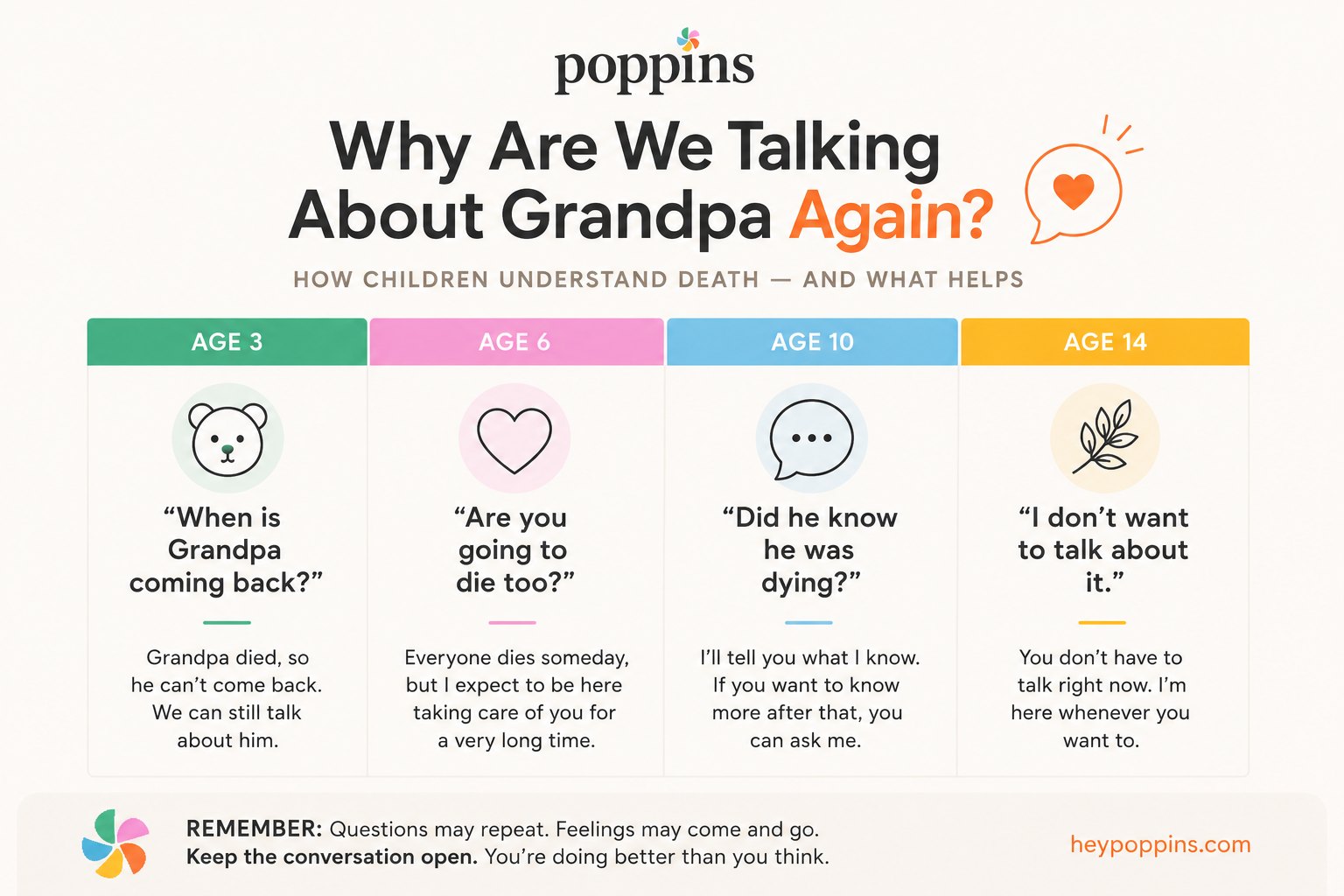
What Kids Are Really Asking When They Ask About Death
Once a child realizes that someone they love can die, another question often follows: “Are you going to die too?”
It's one of those questions that can stop you in your tracks, but underneath it is often something much more immediate than a philosophical curiosity about mortality. Your child may really be asking: Am I safe? Who will take care of me? Could everyone I love disappear?
You don't need to promise something you can't promise by saying, “I'm never going to die.” Instead, you can offer honest reassurance: “Everyone dies someday, but I expect to be here taking care of you for a very long time.”
Then bring the answer back to the world your child can understand right now. “I'm here. You're safe. I'm taking you to school tomorrow, and I'll be home for dinner.”
That kind of practical reassurance matters because loss can change the small routines children depend on. When a grandparent dies, for example, a child may lose not only someone they love but also the person who picked them up every Wednesday, called every Sunday morning, or always sat in the same chair at Thanksgiving.
Meanwhile, you're thinking about funeral arrangements, travel, work coverage, paperwork, and the 47 unread messages lighting up your phone. Your child may simply be wondering, “Who's picking me up tomorrow?”
Tell them.
If Grandma usually handled Tuesday pickup, explain who will now. If you're traveling for the funeral, tell them who will stay with them. If bedtime is going to look different for a few nights, let them know. You don't have to convince your child that nothing will change. You do want them to know that the adults have a plan.
What Grief Actually Looks Like in Kids
One of the most confusing things about childhood grief is how quickly kids can move in and out of it. Your child may cry because they miss Grandpa and ten minutes later ask for Goldfish and go back to building Legos. They may talk about their dog dying on the way to school and then run onto the playground like it's any other morning.
That doesn't mean they didn't understand. And it definitely doesn't mean they didn't care.
Children don't necessarily stay inside grief the way adults sometimes do. Grief can show up through changes in sleep, behavior, concentration, physical complaints, anxiety, or regression—and those reactions can sit right alongside completely normal play.
A preschooler might become clingier or suddenly need you to stay in the room until they fall asleep. A school-age child who has been doing fine may start complaining of stomachaches before school. An older child may become irritable, quieter, or have trouble concentrating. And sometimes a grieving child will laugh, play, go to soccer, argue with their sibling, and ask what's for dessert.
All of those things can coexist with grief.
You also don't need to avoid mentioning the person who died because your child seems happy and you don't want to “remind” them. Talking about Grandpa isn't what created the sadness—his death did. Saying his name, sharing a memory, or acknowledging that you miss him lets your child know this isn't a subject everyone has to tiptoe around.
You don't need to force a conversation, either. You can simply say, “Grandpa would've thought that joke was hilarious,” or “I was thinking about Max today. I miss him.” If your child wants to talk, stay with them. If they change the subject, let them.
The goal isn't to make your child process grief on your schedule. It's to make sure they know grief is allowed in the room.
Helping Kids Say Goodbye—to a Person or a Pet
For many children, the death of a pet is their first close experience with loss. And while the instinct may be to soften it with “we can get another dog someday,” a pet can be a huge part of a child's daily world. The dog was there when they woke up, when they came home from school, when they were sick, and when they went to bed.
That's a real relationship, and it's worth treating the loss like one.
You can say, “I know how much you loved Max. He was part of our family, and it makes sense that you miss him.”
If your child wants to do something to remember their pet, it doesn't need to become a weekend craft project. Choose a favorite photo, draw a picture, plant a flower, write a letter, or tell your favorite Max story over dinner. The point isn't creating the perfect memorial. It's giving your child a way to acknowledge that the relationship mattered.
The same idea applies when a person dies. For many children, being included in a funeral or memorial can be part of understanding what happened and having an opportunity to say goodbye.
Preparation matters more than trying to shield them from every difficult part of the experience. Tell your child where you're going, what the room may look like, that people might cry, and that people might also laugh while telling stories. If there will be a casket or urn, explain that beforehand. If the casket will be open, don't let your child's first explanation of what that means happen when they're standing three feet away from it.
When possible, give your child some choice in how they participate and have another trusted adult available who can step outside with them, find a snack, or leave early. You should be allowed to listen to the eulogy without simultaneously managing a bathroom emergency and “HOW MUCH LONGER?” whispered loudly enough for the entire room to hear.
When You're Grieving, Too
One of the hardest parts of helping your child through grief is that there's a good chance you're grieving the same person.
You don't have to perform “totally fine” for your child. It's okay for them to see you cry. You can be visibly sad while still showing your child that they are safe and cared for.
You might say, “I'm crying because I really miss Grandma. I'm sad, but I'm okay, and you don't need to take care of me.”
That last part matters. Your child can see that adults have big feelings without becoming responsible for managing them.
And if grief plus work plus dinner plus bedtime plus everything else means your household is operating at about 63% capacity for a while, that's okay. Keep the routines that make your child feel secure and lower the bar on the ones that don't. Cereal can be dinner. The laundry can wait. An extra bedtime story isn't going to derail childhood.
Grief also has a way of showing up again long after everyone else assumes the hardest part is over. A birthday, holiday, school event, song, photo, or random Tuesday can bring new questions. As children grow, the way they understand the same loss changes too.
A preschooler who once asked when Grandpa was coming back may become an eight-year-old who wants to know exactly how he died, and later a teenager who wonders what Grandpa would have thought about the person they're becoming.
That's not going backward. It's growing around the loss.
When Your Child May Need More Support
There isn't a correct timeline for childhood grief, so instead of asking whether your child should be “over it” by now, pay attention to how they're functioning.
Some changes in sleep, behavior, mood, concentration, or separation can happen after a loss. But if those changes are severe, persistent, worsening, or significantly interfering with school, relationships, sleep, or everyday life, it's worth checking in with your child's pediatrician or a mental health professional. The same goes for intense guilt or self-blame, significant withdrawal from friends or activities, or anxiety that isn't becoming more manageable over time.
If your child talks about wanting to die, hurting themselves, or joining the person who died in a way that makes you concerned they may harm themselves, seek immediate professional help.
You don't have to figure out on your own whether something is “normal grief” or something that deserves more support.
You Don't Have to Get This Right in One Conversation
There is no flawless script for telling a child that someone they love died.
Your child probably won't remember whether you found exactly the right sentence. They'll remember that they were allowed to ask the weird questions, the scary questions, and the same question for the seventh time. They'll remember that it was okay to cry and also okay to go play five minutes later.
And they'll remember that even when something very sad happened, the people taking care of them were still there.
So be clear. Be honest. Keep your answers as small as the question in front of you.
And leave room for the next one.
TL;DR
Talking to kids about death isn't one perfect conversation. Use clear words like “died” instead of confusing euphemisms, give honest and age-appropriate answers, and expect younger children to ask the same questions repeatedly as they learn what death means. Grief can look like sadness, behavior changes, anxiety, physical complaints, or completely normal play—and all of those reactions can exist side by side. Keep the person's memory part of family conversation, prepare children for funerals or memorials rather than surprising them, and let your child see that you can be sad while still being their safe adult. Most importantly, keep the conversation open. Children understand loss differently as they grow, so new questions may come long after the first one.
Need Help With What Comes Next?
Sometimes the hardest part isn't knowing that you should talk about death. It's figuring out what to say to your specific child, at their specific age, while you're grieving and still somehow expected to remember that tomorrow is pajama day at school.
A Poppins Certified Parent Coach can help you navigate the conversations, behavior changes, routines, and questions that come with grief and loss. If you're concerned about changes in your child's sleep, appetite, physical symptoms, behavior, or overall health, the Poppins medical team can help you figure out what deserves a closer look.
What does your child seem to need most from you right now—an answer, reassurance, space, or simply permission to feel whatever they're feeling?