Anxiety & Big Emotions in Kids: What Parents Can Do When Feelings Take Over

Your kid is on the floor in pajamas, furious because the banana broke in half, while you are staring at the clock, thinking about the meeting you are already late for. Welcome to parenting: where a snack can become a five-alarm emotional event before 8 a.m.
Big emotions are not a parenting failure
Children can have enormous feelings before they have the language, impulse control, or perspective to manage them. Anxiety can make that gap even wider. A child may cling at school drop-off, complain of a stomachache before a big event, melt down over a seemingly tiny change, ask the same “what if?” question 17 times, or suddenly insist they cannot do something they handled easily last month.
That does not automatically mean something is seriously wrong. It does mean the behavior is information. The goal is not to eliminate every uncomfortable feeling—an impossible assignment for both children and adults—but to help a child learn what to do when the feeling shows up.
That is also the point of World Mental Health Day, observed each year on October 10: making mental health visible, talking about it without stigma, and connecting people with support when they need it. The World Health Organization frames the day as an opportunity to raise awareness and mobilize support for mental health.
First, separate a big feeling from a big problem
A child can be having a very big reaction to a very small problem. Those two things can coexist. Your job is not to convince them that the feeling is ridiculous; it is to help their nervous system come back online so problem-solving is possible.
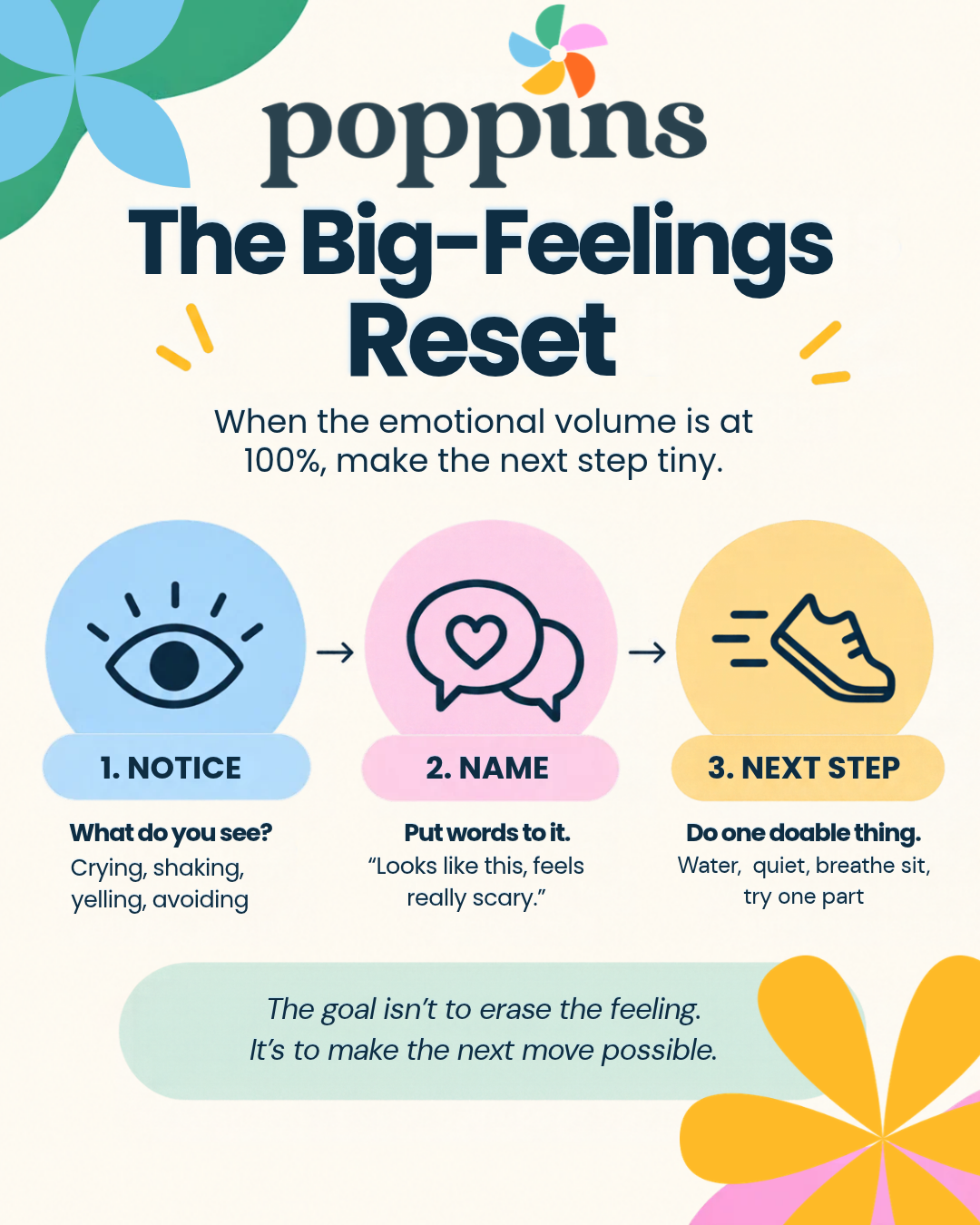
Try this sequence: Notice → Name → Next step.
1. Notice what is happening
Start with what you can actually see: “Your hands are shaking,” “You are crying really hard,” or “You seem worried about tomorrow.” Skip the courtroom-style cross-examination while everyone is activated. You do not need a five-question interview from the floor of the kitchen.
2. Name the feeling without overpromising
“I think this feels really scary.” “You are disappointed.” “You are angry that the plan changed.” Naming the emotion can give a child a handle to grab onto. And if you get it wrong, they can correct you: “No, I’m not scared. I’m embarrassed.” Great. Now you have useful information.
3. Pick one next step
When emotions are high, keep the next step tiny. Take three slow breaths. Get a drink. Sit beside me. Move somewhere quieter. Try the first part together. Send the teacher one message. Put tomorrow’s worry on a piece of paper and deal with it after dinner. The objective is movement, not a TED Talk.
Parent coach Raelee Peirce says, “When a child is overwhelmed, connection usually has to come before correction. We can acknowledge the feeling without giving the feeling the steering wheel. The message is: I see this is hard, and I’m here to help you figure out what comes next.”
What anxiety can look like in real life
Anxiety does not always announce itself by saying, “Hello, I am anxiety.”
In children, it may show up as irritability, avoidance, perfectionism, repeated reassurance-seeking, difficulty separating, sleep problems, headaches or stomachaches, or a sudden increase in emotional outbursts.
Look for patterns rather than one rough afternoon. Is your child increasingly avoiding school, activities, friends, sleepovers, sports, or other things they used to enjoy? Are worries interfering with sleep, eating, school attendance, family routines, or relationships? Does the same concern keep returning despite reassurance? Those patterns are more informative than whether your child had one spectacular meltdown over the wrong color cup.
The American Academy of Pediatrics has expanded its focus on healthy mental and emotional development and provides family resources specifically for anxiety, sadness, disruptive behavior, and social-emotional health. Its guidance reflects an important idea: mental health belongs in ordinary pediatric care, not only in a crisis.
The after-school emotional explosion is a thing
You may see your child hold it together at school, daycare, or activities and then completely unravel at pickup. This can be especially frustrating when the school says, “They had a great day!” and your child gets into the car and starts sobbing because the granola bar was the wrong flavor.
Often, the transition itself is part of the problem. Your child has spent hours following rules, navigating people, managing noise, making decisions, and using self-control. Then you arrive—the safest person in the room—and the lid comes off.
Instead of launching into “What happened?” and “Why are you acting like this?” try a low-demand landing zone: a snack, water, quiet music, a few minutes without questions, and predictable connection. Save the investigation for later if it still matters.
How to respond when anxiety is driving the behavior
Avoid the reassurance treadmill
If your child asks, “Are you sure nothing bad will happen?” you can answer once. But if the same question comes back 12 times, repeating “Yes, I promise” may accidentally teach them that they need another reassurance hit every time anxiety rises.
Try: “I already answered that, and I know your worry is asking for another answer. Instead, let’s practice what you can do when the worry shows up.” You are validating the child without making certainty the goal.
Do not make avoidance the default
If anxiety makes school, birthday parties, sports, sleepovers, or doctor visits difficult, it is tempting to simply remove the trigger. Sometimes a break is exactly right. But long-term, repeated avoidance can make the feared situation feel even bigger.
When appropriate, work with your child's pediatrician, therapist, or school team on gradual, supported exposure rather than forcing a child into the deep end. Think small steps, predictable support, and repetition—not “surprise, you're staying at camp all week.”
Keep the adult nervous system in the room
Kids borrow our regulation. That does not mean you need to become a meditation guru while someone is screaming about socks. It means lowering your voice, slowing your words, and resisting the urge to match their intensity can help create a little more room for everyone to think.
Parent coach Raelee Peirce recommends looking at the whole pattern: “A single emotional blowup is usually less important than a change in your child’s baseline. If anxiety or big emotions are consistently interfering with sleep, school, friendships, eating, family life, or activities, that is a good reason to bring it to the pediatrician rather than waiting for it to become a crisis.”
When it is time to call in more support
You do not need to prove that your child has a diagnosis before asking for help. Start with the people who already know your child: their pediatrician, school counselor, teacher, or a mental health professional. Bring specifics: when it started, what triggers it, how often it happens, what it looks like, what makes it better or worse, and whether it is affecting sleep, school, friendships, eating, or activities.
Seek prompt professional help if your child is talking about wanting to die, self-harm, hurting someone else, feeling unable to stay safe, or showing a sudden and severe change in behavior. If there is an immediate safety concern, use emergency services or a crisis resource rather than trying to troubleshoot it at home.
For school-related concerns, SAMHSA also offers resources for families and schools addressing children's mental health. These can be useful when the problem is not just happening at home and you need adults across the child's day working from the same plan.
A five-minute plan for the next big-feelings moment
You do not need a color-coded binder. Keep this somewhere you can actually find it:
- Pause before correcting. Lower your voice and slow your words.
- Name what you see: “You look worried,” “That was really disappointing,” or “Your body seems overwhelmed.”
- Offer one regulating action: water, breathing, movement, quiet, a hug, or space.
- Set the boundary if there is unsafe behavior: “I won't let you hit. I will stay with you while you calm down.”
- Choose one next step. Save the bigger conversation for when everyone is regulated.
- Track patterns for a week if this keeps happening. Patterns help clinicians and school teams much more than “they've been emotional lately.”
Mental health care does not have to wait for a crisis
Mental health is part of health. That means you can bring anxiety, frequent meltdowns, school refusal, sleep changes, or persistent worries to a pediatric clinician just like you would bring a cough that will not quit. The AAP's family mental health resources include practical information on anxiety and social-emotional health, while the WHO's World Mental Health Day campaign is a useful reminder that talking about mental health is part of caring for it.
And sometimes the most helpful first step is not a diagnosis. It is having someone who can help you sort the problem into: What can we handle at home? What should we tell the school? What should we track? And when does this need a clinician? That is exactly where a Poppins parent coach or medical provider can help.
The goal is not to raise a child who never melts down, worries, gets embarrassed, or has a terrible afternoon. The goal is to raise a child who gradually learns: feelings can be big without being dangerous, I can ask for help, and there are things I can do next.
Before the next big-feelings moment hits, ask yourself: What is my child trying to tell me with this behavior—and what is the smallest useful next step I can help them take?
TL;DR
- Big emotions are not automatically a sign that something is wrong. Look for patterns, especially when anxiety or emotional outbursts begin interfering with sleep, school, friendships, eating, activities, or family life.
- When feelings take over, remember Notice → Name → Next step. Notice what is happening, name the feeling, and choose one small action that helps your child move forward.
- You can validate a feeling without letting anxiety make every decision. Avoid getting stuck in repeated reassurance or making avoidance the default.
- If big emotions keep happening, track what triggers them, what helps, and how they are affecting daily life. Those details can help a pediatrician, school team, or mental health professional understand the bigger picture.
- You do not need to wait for a crisis to ask for support. A Poppins parent coach or medical provider can help you figure out what you can handle at home and when your child may need additional care.