I'm Bored! Now What? Understanding Summer Boredom as a Signal to Connect

The Summer Soundtrack Nobody Asked For
At 2:43 on a Tuesday, your child has already eaten two popsicles, asked for another snack, wandered into your workspace three times, and announced-with Oscar-worthy dramatic flair-that there is "absolutely nothing to do."
Meanwhile, you're trying to finish one more email before camp pickup, remember whether you signed the permission slip for Friday, and mentally calculate if leftovers can somehow become dinner. Summer is supposed to feel slower, but for many families it simply trades one kind of busy for another.
Then it happens.
"I'm bored."
Those two words have an uncanny ability to trigger instant guilt. Maybe I should have planned more. Maybe we need another activity. Maybe I'm not doing enough.
But here's something worth considering: "I'm bored" is rarely about the absence of activities. It's often a signal that your child is looking for something much closer to home: connection with you.
What Boredom Really Signals
Think about it. During the school year, your child's day is full: bells ring, teachers transition the class, practices begin at a set time. An adult's rhythm carries them. Summer suddenly hands children something they've had very little practice managing wide-open time without a relational anchor.
When a child says, "I'm bored," they might be saying, "I lost my sense of where I belong," or "I don't feel anchored right now," or simply, "I need to be near you before I know what comes next."
This isn't a flaw in your parenting. It's a sign of how deeply your child depends on connection to feel grounded enough to play, explore, and create.
Why We Rush to Rescue
Most of us respond to boredom with kindness and speed. We suggest a craft, a bike ride, a science kit, or a trip to the park. The intention is loving, but the pattern can unintentionally teach children that someone else will always supply the next idea, and more importantly, that their real need (connection) can be satisfied by an activity instead.
What if, instead, we paused to ask: Does my child need to reconnect with me first? Am I their anchor right now, or are they trying to find one?
The Relational Foundation
Children are born dependent. This isn't something to outgrow, it's the soil from which genuine independence and creativity eventually grow. When a child feels securely connected to you, something shifts in their energy. They become more curious, more playful, more willing to explore. When they don't have that sense of connection, they become preoccupied with finding it, which looks a lot like restlessness, demanding behavior, or endless complaints of boredom.
Researchers call this secure base the foundation for exploration. But it works the other way too: when the secure base feels disrupted, all the child's energy turns inward to reestablishing connection rather than outward to play.
Your presence, calm, warm, and consistently there, is the relational soil where a child's creativity and independence can unfold naturally. Not through pushing them to do things alone, but by being the home base they can return to between ventures forth.
"Your job isn't to make your child independent of you right now," says Raelee Peirce, Poppins Parent Coach. "Your job is to be so reliably, warmly, consistently present that they don't have to use their energy looking for you. That's when they're free to look toward themselves and their own ideas."
The Pause Before Response
Before offering a list of activities, pause. Check three things:
- Has your child eaten or had water recently? Hunger clouds everything.
- Are they overtired? Exhaustion masquerades as boredom.
- Are they just looking for a few minutes of your presence before they branch off on their own? This is the one everyone misses.
Most of the time, a short stretch of connection: sitting together, talking about their day, playing a quick game, even just being in the same room while they tell you about their thoughts, is enough to send them back out into play with renewed energy.
Connection First, Activity Second
Consider these two responses to "I'm bored."
One approach is to immediately jump into solving the problem: "Go find something to do." Or, "How about LEGOs? Coloring? Going outside?" These responses assume your child needs an activity.
Another approach starts with connection instead. You might say, "Come sit with me for a few minutes. Tell me what you're thinking about." Or, "You seem like you need to be near me right now. Let's spend a little time together, and then maybe something will spark for you."
The second response assumes that what your child is signaling through boredom is a relational need, not an activity deficit. It also gives them the gift of seeing that you're willing to be with them before anything else happens.
"When you pause instead of jumping into solutions," Raelee Peirce explains, "you're making a profound shift. You're saying, 'I see you. You matter more to me than fixing this moment.' That pause is where connection happens. And connection is where everything else becomes possible."
What Happens Next
Something remarkable often happens when a child has had a few genuine moments of connection. Their eyes brighten. Their body relaxes. They remember something they wanted to build, draw, or explore. Not because you suggested it, but because now they have the anchor they needed to venture out.
This is how independent play emerges, not from activities we impose, but from the safety of a secure relational home base.
When a child feels truly present to you, they gradually become present to themselves and their own ideas. When they feel securely held by you, they become able to hold their own attention to something they care about. This is the real gift of unstructured summertime, not that you finally get to rest (though you might), but that your child gets to practice being with themselves in a way that only happens when they've first been with you.
"Parents sometimes worry that being available is spoiling their child or preventing independence," says Raelee Peirce. "But the truth is the opposite. When a child has truly felt held, they eventually let go. When they know they belong somewhere, they're free to belong to themselves. That's the real emergence we're building toward."
Independent Play at Every Age
Independent play develops gradually with age, but every stage begins with connection. Here's what independent play typically looks like—and what children need from caregivers before they're ready to explore on their own.

Building a Summer Rhythm (Not a Schedule)
Once children know when they can count on your time and attention, they're often more willing to explore on their own. This example shows how a simple daily rhythm can create those predictable moments of connection.
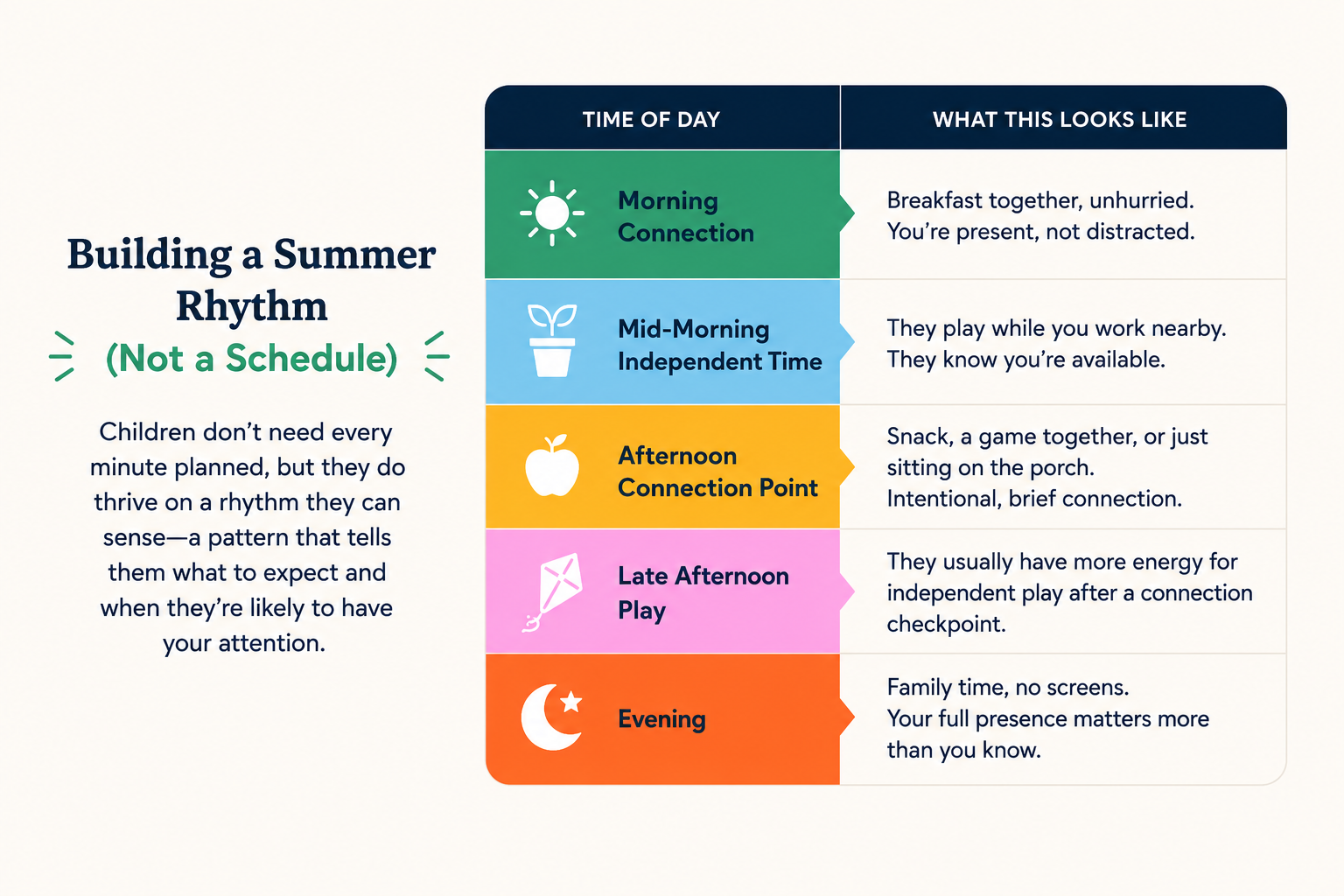
The rhythm doesn't need to be rigid. The point is that your child knows when they can count on your time and attention, which often reduces the urgent calls for connection throughout the day.
When Boredom Persists
If a child remains listless even after connection, if nothing sparks their interest and everything feels flat, this can be a sign of something else. Exhaustion, overstimulation earlier in the year, anxiety, or even depression can hide underneath persistent boredom. If this is what you're noticing, it's worth talking to your pediatrician.
But in most cases, the boredom is less about what's wrong and more about what's needed: your presence, your interest, and the safe feeling of knowing that you're there before they venture forth again.
The Long View
One day, the interruptions, snack requests, and dramatic declarations of boredom will quietly disappear. What will remain are the habits your child developed during those ordinary summer afternoons, the sense that they matter to you, that their ideas and feelings are welcome, and that the world is a place where they can both belong and be themselves.
Those summers of boredom and connection aren't lost time. They're the relational bedrock that holds all of your child's growth. And every time you pause to be present instead of rushing to fix, you're building something that will serve them far beyond the summer months.
The next time your child says, "I'm bored," pause before answering. Ask yourself: Is this a problem to solve or an invitation to connect? The answer may change the entire afternoon, and the confidence your child is building along the way.
Work with a Parent Coach
Need support creating a summer rhythm that works for your family, navigating your child's behavior, or building a stronger relational connection with your kids? A certified parent coach can partner with you to develop practical, personalized strategies.