First Day Camp, First Night Away: A Parent's Guide to Camp for Kids Ages 3–9

The school year ends and suddenly the structure that's been holding everything together — the schedule, the routine, the place your kid goes every day — disappears. For parents of preschoolers and early elementary kids, that transition raises a real question fast: what does summer actually look like, and is your child ready for it?
Camp is often the answer. But which kind, at what age, with how much time away from home — that's where it gets complicated. This guide covers what format makes sense at each stage, what readiness actually looks like before you commit, how to prepare a kid for time away, what to pack, and the questions parents don't always feel comfortable asking — including what to do if your child wets the bed at camp.
One thing worth naming upfront: readiness is not strictly about age. Emotional maturity and self-care skills matter more than a birthday. Keep that in mind as you read.
Day Camp vs. Sleepaway Camp: What's Actually Different
The two formats are not just the same program with different bedtimes. The level of independence required, the cost, and how much contact you'll have with your child are meaningfully different — and understanding those differences is what helps you pick the right fit for where your kid is right now.
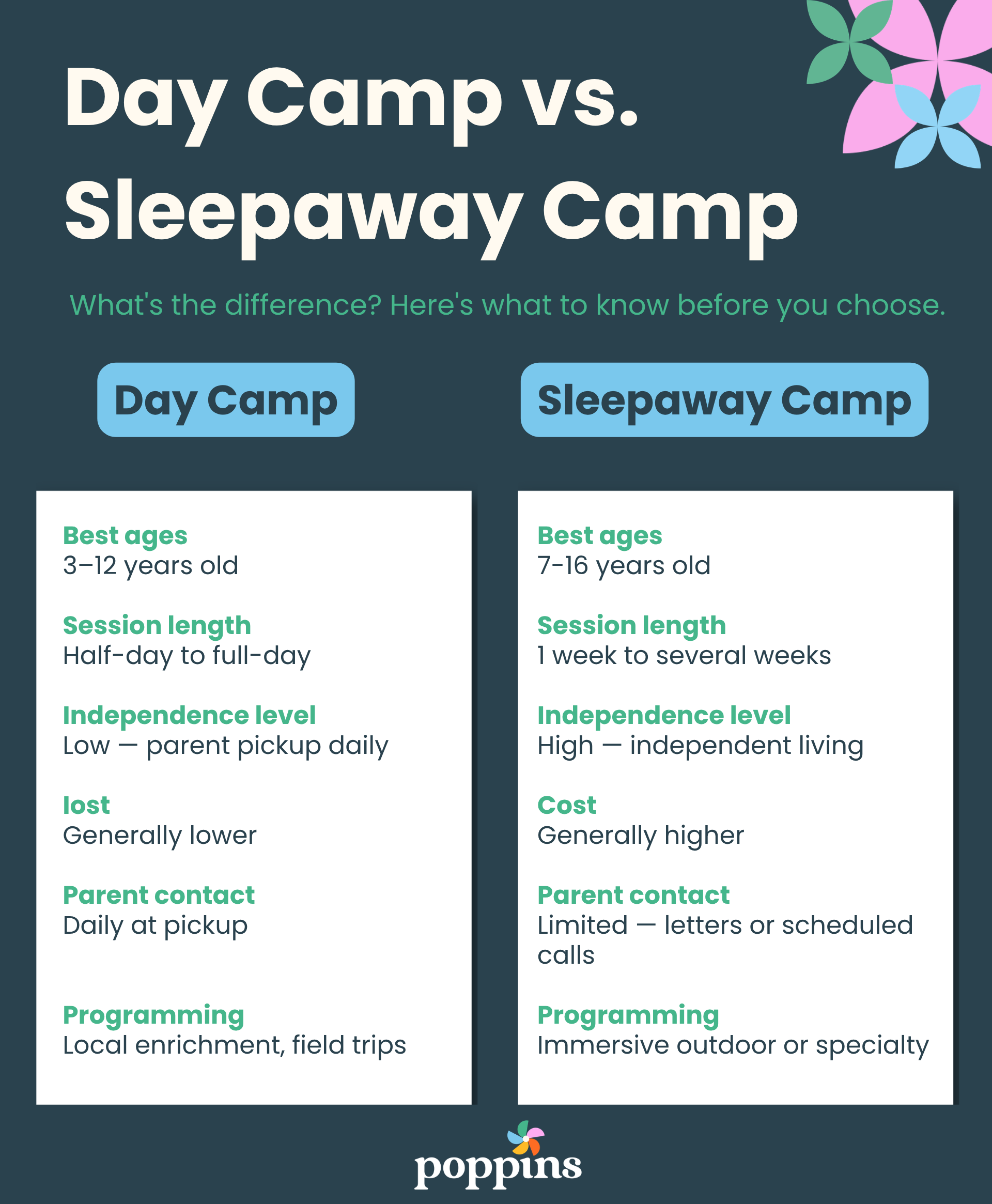
The ACA generally recommends day camp as the transitional experience for younger children, and specifically notes that children under age 7 may not adjust easily to overnight camp. That's not a hard rule — it's a data point.
Age-by-Age Guide: Who's Ready for What
Here's where the abstract advice gets concrete. Because "is my kid ready" is only useful if you know what you're measuring.
.png)
Preschool (Ages 3–5): Day Camp, and Finding the Right Length
Short sessions — half-day or partial-week — with small group ratios and routines that mirror preschool structure are what work at this age. You're looking for familiarity, not novelty.
Readiness markers here are basic but real: Is your child comfortable with a non-parent caregiver? Can they tell an adult when they need the bathroom, when they're hungry, or when something hurts? Can they get through a morning without falling apart?
The most common mistake at this stage is matching the camp length to your schedule rather than your child's endurance. A full-day camp is a cleaner logistics win when you're working — one drop-off, covered until 3pm. But if your kid has only ever done half-day preschool, you're trading a logistics problem for a much harder one. A half-day program with a sitter or family member covering afternoon pickup and nap is a less elegant solution on paper and genuinely the right one. Start where your child is, even if it means patching together coverage.
Early Elementary (Ages 6–7): Day Camp, With Room to Test the Waters
Day camp remains the primary recommendation here. Some kids in this range will start asking about sleepaway camp — often because an older sibling went, or because a friend is going — and that interest is worth taking seriously without acting on it immediately.
Short taster overnights, one or two nights at a family camp or weekend program, can be a genuinely useful bridge. They give a child (and you) a reference point that isn't the full commitment of a week-long session.
Readiness markers: Has your child successfully slept at a grandparent's or a friend's house? Do they handle basic self-care — dressing, brushing teeth, using the bathroom — with reminders rather than management? Is the interest in camp consistent, or was it one excited conversation after a playdate?
As Raelee Peirce, a Poppins Certified Parent Coach, puts it: "The question isn't whether your child wants to go — it's whether they have the tools to handle the hard moments when you're not there to step in. Wanting it and being ready for it aren't the same thing, and closing that gap is actually something you can work on together before camp even starts."
Older Early Elementary (Ages 8–9): Sleepaway Is on the Table
Most children become candidates for short sleepaway sessions — three to seven nights — in this range. Many children are ready for overnight camp by about age 7 or 8, though readiness varies widely. Specialty day camps in sports, science, and the arts also tend to expand at this age, which gives confident kids who aren't ready for overnight camp something genuinely interesting to do.
The readiness markers shift here: Can your child manage their own belongings without losing them all? Do they follow multi-step instructions? Do they recover from minor disappointments — the wrong cabin assignment, rain on the day of the canoe trip — without needing a parent present? And critically: is the interest in camp something that's been consistent over time, or is it an impulse from last Tuesday?
The pitfall to watch for: assuming that a capable, confident kid at home will translate directly into a capable, confident kid in a new environment with unfamiliar adults. Those are different skill sets, and the transition is real.
How to Prepare Your Child for Time Away
Preparation is not a single conversation the night before drop-off. It's a runway — and the longer the runway, the smoother the launch. Here's how to build one that actually works.
- Talk about camp positively and realistically. Acknowledge that missing home is normal. The AAP defines homesickness as a normal response to separation, not a problem to be fixed. Over-selling camp — "You're going to love every single second!" — sets the wrong expectation and makes it harder for your child to tell you when something is hard.
- Build a history of separation before camp starts. A sleepover at grandparents' house, a weekend with relatives, or a longer day program before a sleepaway attempt all give your child reference points. The goal is that "I've done this before" feeling. The more of those experiences a child has going in, the less camp feels like a jump into the unknown.
- Tour the facility before the first day. Most camps welcome visits — call ahead and ask. Walking the grounds, seeing the cabins or classrooms, and identifying the bathrooms removes a lot of unknowns. Unfamiliar environments are harder to be brave in.
- Practice the self-care skills camp requires. Showering independently. Applying sunscreen. Packing and organizing a backpack. Managing a water bottle. These sound obvious, but if your child has never done them solo, camp is not the moment to figure it out. Work them into the regular routine well ahead of time.
- Set communication expectations clearly. For sleepaway camps, clarify how often your child will receive letters or calls before they leave — not at drop-off. Avoid open-ended "you can always come home" framing. Research suggests this actually increases homesickness rather than reducing it. Confident, calm drop-off energy from you is one of the most effective interventions available. Your child is reading your cues.
Confident, calm drop-off energy from you is one of the most effective interventions available. Your child is reading your cues.
What to Pack: The No-Nonsense Lists
Most camps will give you a specific packing list at registration — use it. What follows is the framework of categories, based on ACA packing guidance, so nothing gets overlooked.
Day Camp Essentials
- Labeled water bottle
- Sun hat, sunscreen (camp-approved formula if specified), sunglasses
- Swimsuit and towel (if water activities are included)
- Closed-toe shoes, plus a second pair for water or play
- Change of clothes in the backpack
- Lunch and snacks if not provided
- Insect repellent
- Backpack large enough to hold all of the above
Sleepaway Camp: Everything Above, Plus
- Sleeping bag and pillow (or twin bedding, depending on the camp setup)
- Multiple clothing changes for the full session, plus a few extras
- Rain gear and a warm layer for cool evenings
- Toiletries in a shower caddy or bag
- Laundry bag
- Flashlight or headlamp with extra batteries
- Stationery and pre-addressed, pre-stamped envelopes so letters actually get sent
- Prescription medications in original packaging, handed directly to the camp nurse at check-in
One universal rule that every camp source repeats, for good reason: label everything. Every single item. Before camp, not after.
Common Concerns Parents Don't Love to Bring Up
Homesickness
It is common, it is normal, and it is usually short-lived. According to the AAP, 83 percent of campers reported homesickness on at least one day of camp. Most cases resolve within a few days as kids settle into routines and relationships. The ones that don't are usually connected to a child who wasn't quite ready — which is an argument for the age-by-age framework above, not a reason to avoid camp altogether.
Bedwetting at Camp
This comes up more than parents expect, because it is more common than parents expect. About 5 to 15 percent of school-aged children experience some form of bedwetting, and most camps have well-established, discreet procedures for handling it.
If bedwetting is a concern, here's the practical approach:
- Contact the camp director or nurse before arrival. They've handled this before. They will not make it a thing.
- Request a bottom bunk near the bathroom.
- Pack absorbent nighttime underwear, extra pajamas, extra sheets, plastic bags for storing wet items, and a flashlight within arm's reach of the bed.
- Reduce fluids 60 to 90 minutes before bedtime and use the bathroom immediately before sleep.
- This is exactly where Poppins can help. If it’s appropriate for your child, the Poppins medical team can prescribe Desmopressin (DDAVP) — a fast-acting synthetic hormone that temporarily reduces overnight urine production and works on the first dose. It's worth getting this sorted early in the planning process, not the week before drop-off.
As Aly Insull, Poppins Pediatric Nurse Practitioner, explains: "Bedwetting is one of the most common things parents quietly worry about before camp — and one of the least talked about. The good news is there are safe, effective options that work quickly. If it's on your radar, loop in the Poppins medical team early. A conversation before camp is a lot easier than managing it after the fact."
Picky Eating, Allergies, and Medications
All three are routine for camp medical staff. Complete the health forms accurately. Do not downplay or omit conditions in the interest of not making it a big deal — the medical team cannot help with what they don't know.
The Bottom Line
Getting a kid ready for camp — whether it's their first morning drop-off or their first week away — is as much about the parent as it is about the child. The logistics are manageable. The emotional piece is where most families get tripped up.
If your child has a medical need that feels complicated to hand off — bedwetting, a prescription, an allergy protocol — don't navigate that alone. Contact the camp's medical staff early, come with documentation, and loop in the Poppins medical team before registration closes. We can help get the right plan in place before camp starts.
And if you're less sure about the readiness question — whether your kid is actually ready, how to handle the separation, how to prep a child who's anxious about being away — that's exactly what a Poppins Certified Parent Coach is there for. Not to tell you what to do, but to help you build a plan that fits your specific kid. Connect with a coach here.
TLDR
- Day camp is appropriate starting at age 3; sleepaway camp is typically for ages 7–8 and up.
- Readiness is emotional and skill-based, not just age-based.
- Build a runway: separations, facility tours, and self-care practice before camp starts.
- Label everything. Have the homesickness conversation before it happens. Call the nurse about bedwetting in advance.
- A calm, confident drop-off is one of the most effective tools you have.
Something to sit with: What's one thing your child would need to handle independently at camp that they've never had to handle independently at home — and is there time before camp starts to practice it?