Why Your Child Won't Eat (And Why That's Okay): A Developmental Approach to Picky Eating

Here's the truth about that untouched plate staring you down from across the dinner table: your child isn't being difficult. They're being developmentally appropriate. And once you understand what's actually happening in their brain, everything about how you approach mealtime can shift.
Picky eating isn't a behavior problem to fix, it's a developmental signal to understand. And the difference between those two perspectives? That's the difference between years of mealtime battles and raising a kid who actually enjoys eating.
Understanding the Brain's "Caution Setting"
Your child's refusal of new foods isn't defiance. It's their brain doing exactly what it evolved to do: protect them.
That cautious approach to new foods? It's called neophobia, and it's been keeping little humans alive for millennia. Your toddler's suspicious glare at the broccoli isn't some character flaw, it's their ancient survival instinct saying, "Hmm, this green thing is unfamiliar. Better stick with what I know won't poison me." That cauliflower you're serving? Your toddler's ancient brain genuinely registers it as a potential threat until proven otherwise.
Children's brains are wired to be suspicious of unfamiliar foods, an evolutionary protection mechanism that kept our ancestors from eating poisonous berries or sketchy mushrooms. This isn't a bug in the system. It's a feature.
Here's the part that changes everything: acceptance requires repetition. Most foods need 10-15 neutral exposures before a child's brain decides, "Okay, I've seen this enough times. Everyone else is eating it and surviving. Maybe it's safe."
The problem? Most parents give up after 2-3 attempts. We offer broccoli twice, the kid says no, and we conclude, "Well, they hate broccoli." But we've barely scratched the surface of what the brain needs to feel safe.
And here's the kicker: "exposure" doesn't mean eating. Simply seeing food nearby, on the table, on someone else's plate, in the kitchen, lowers the brain's alarm over time. Think of it like slowly turning down the volume on a car alarm. Each exposure turns it down just a notch, until eventually, the alarm stops blaring altogether.
Just as children need to feel secure in their attachments before they can venture forth and explore the world, they need to feel safe at the table before they can venture forth and explore new foods. Curiosity, whether about the playground or about new tastes, emerges naturally when anxiety is removed.
Why Pressure Backfires (And What Works Instead)
When we push children to eat, we trigger their alarm system, the exact opposite of what we want. Pressure turns on the fight-or-flight response, and suddenly eating becomes a battle of control rather than a nourishment experience.
Children are hardwired to resist demands. It's not personal. It's developmental. When you say, "You have to eat this," their brain hears, "Someone is trying to control my body," and instinct kicks in: resist.
But here's what most parents don't know: children are far more likely to accept foods they've explored without expectations. The nervous system pathway to acceptance actually goes like this: touch → smell → sight → taste (in that order).
That means your kid needs to play with food before they'll eat it.
Let them help in the kitchen, not because you need a sous chef, but because exploration is the gateway to acceptance. Hand them vegetables to wash "just for helping," not for eating. Let them tear lettuce, stir sauces, arrange food on plates. They're gathering sensory data: texture, smell, appearance. Their hands are telling their brain, "This is safe." Long before taste ever enters the picture.
"Remember to balance the bites with the battle," says Jessica Kimmes, Pediatric Nurse Practitioner at Poppins. "Offering choices and staying calm is all you can control, and by doing that, you're doing a great job!"
We cannot command curiosity. We can only create the conditions for it to emerge. When we try to force outcomes, we suffocate the natural "venturing forth" energy children need to try new things. Play and exploration are the spaces where the brain learns that something is safe.
Returning Choice to Your Child
When we try to control what and how much a child eats, we interfere with their natural development of autonomy. This isn't just about dinner, it's about the fundamental human need for self-determination.
Pre-plated meals send a message: "I've decided what and how much you need." But children are born with innate hunger regulation. They know when they're full, when they're hungry, and what their bodies need, if we don't override those signals with external pressure.
"True independence cannot be pushed from the outside; it must emerge from within," explains Raelee Peirce, Poppins Parent Coach. "When we try to control what and how much a child eats, we interfere with their natural development of autonomy. The child who is allowed to make choices at the table, even small ones, is building the internal compass they'll need for healthy eating throughout life."
The psychological principle here is simple: ownership creates investment. When children have agency over their food choices, they're more likely to engage with eating because it's their decision, not a demand being placed on them.
And modeling matters more than you think. Children aren't listening to lectures about nutrition, they're watching your behavior and deciding whether food is something to be enjoyed or endured. They're absorbing how you relate to food: Do you eat with pleasure or guilt? Do you speak about your body with criticism or neutrality? Do you label foods as "good" and "bad," or do you simply eat what your body needs?
When you stop being the enforcer, your child stops being the resister. Suddenly, there's space for curiosity to show up.
The Anxiety-Curiosity Connection
Here's a fundamental truth about how brains work: anxiety shuts down curiosity completely. The brain can't explore when it feels threatened.
When a child looks at a table and worries, "What if there's nothing I can eat?", that's it. Game over. The nervous system goes into survival mode, and no learning happens. This is why pressure backfires so spectacularly. You're trying to expand their palate, but you're actually activating the exact brain state that makes exploration impossible.
The solution isn't to force them to try new things. It's to lower their baseline anxiety enough that curiosity can emerge naturally. When kids feel safe, emotionally and physically, they become adventurous. When they feel pressured, they shut down.
This is why strategies that seem permissive (like including familiar foods at every meal, or not requiring them to eat anything) actually work better than strategies that seem rigorous. You're not lowering your standards. You're working with developmental psychology instead of against it.
Beyond "Good Food" and "Bad Food"
Let's talk about the language we use around food, because it's creating problems you don't even realize.
Labeling foods as "good" or "bad" activates the brain's desire for what's forbidden. Children (and adults, let's be honest) naturally crave what feels restricted. You want to create a fixation on cookies? Tell your kid they're "bad" and only allow them as a "treat."
Teaching function works better than judgment: "This gives your body energy for running" versus "This is unhealthy." When treats are served matter-of-factly alongside other foods, they lose their special power. Restriction increases fixation. Normalization creates balance.
Here's the language shift that changes everything:
Instead of: "That's junk food"
Try: "That's a sometimes food" or simply name it without judgment
Instead of: "You can't have dessert until you eat your vegetables"
Try: Serve a small dessert portion alongside the meal (no conditions attached)
Why: Using dessert as a bargaining chip teaches kids that vegetables are the punishment you must endure to get to the reward. It assigns moral hierarchy to food and creates the exact obsession with "treats" that you're trying to avoid. Alternatively, because we get that a cookie next to broccoli might feel confusing, you can give dessert once the dinner meal is over. Think of it as a casual after-dinner course and avoid making it a big deal. Dessert after dinner isn't the problem, it's the bargaining and using it as an award that is. Avoid the "nice job eating your dinner! You earned dessert." A quiet delivery of a cookie or an ice pop without the connection to what they ate at dinner leads to more success.
Instead of: "Sugar is bad for you"
Try: "Your body uses different foods for different jobs"
Instead of: "Eat your healthy food first"
Try: No commentary, all food is just food
When we remove moral judgment from food, we remove the emotional charge. And when food isn't emotionally charged, kids can develop a balanced relationship with it.
Playing the Long Game
Appetite regulation is innate. Children's bodies know how much they need. Your job is to provide nutritious options in a calm environment. Their job is to decide what and how much to eat.
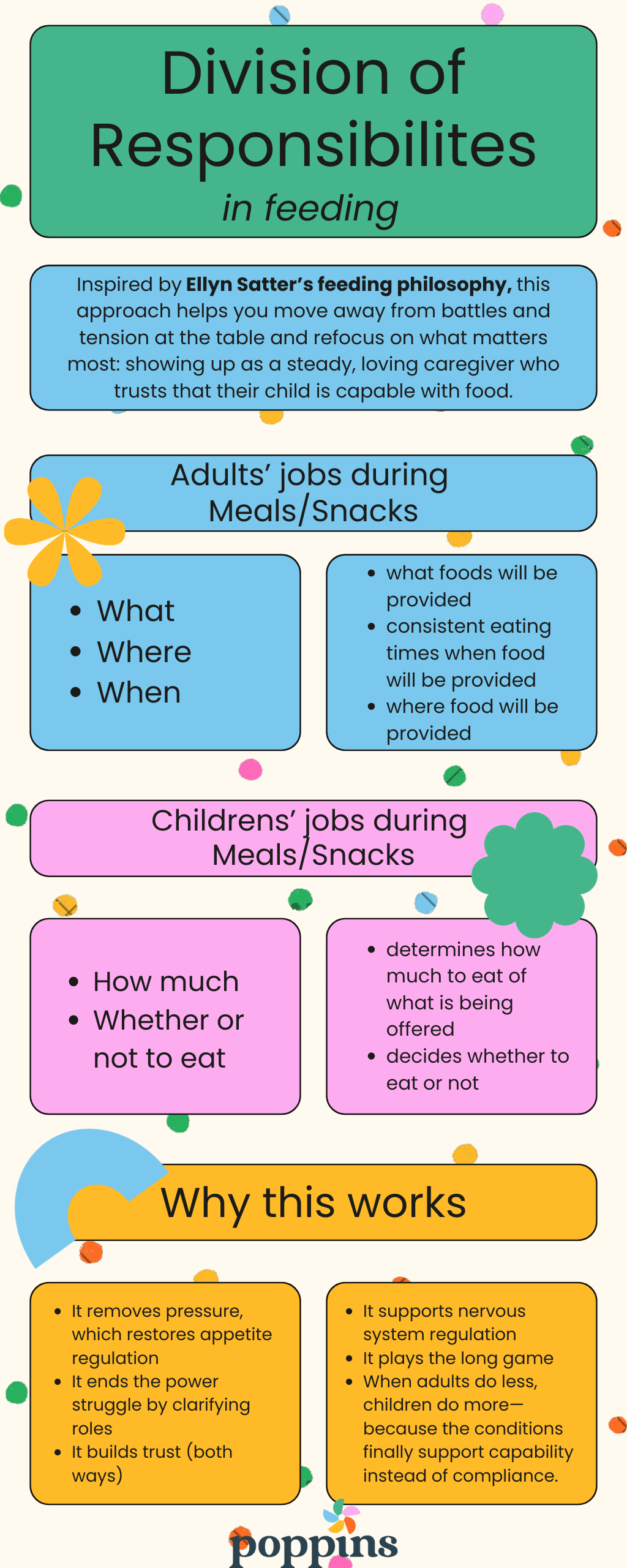
Growth happens in seasons. Some weeks your child will eat like a competitive eater. Other weeks, they'll survive on what seems like three crackers and vibes. This is normal. Their growth is slowing, their appetite is adjusting, and their body is doing exactly what it should be doing.
Children raised without food pressure develop healthier relationships with eating. They trust their hunger cues. They eat when they're hungry and stop when they're full. They don't binge when "forbidden" foods are available because nothing has been forbidden.
Development cannot be rushed. Just as we cannot teach a child to become curious or creative, we can only provide the conditions and wait for nature to do its work, we cannot force a child into healthy eating habits. What we can do is make intentional choices: choosing what types of snacks we offer in the home, what we model with our own eating, how we talk about food.
What we can do is remove the obstacles: pressure, anxiety, moral judgment, and power struggles. When these barriers are removed, children's natural relationship with food can unfold.
The Goal Isn't Tonight's Dinner
The goal isn't to get your child to eat their vegetables tonight. It's to raise an adult who has a healthy, curious, peaceful relationship with food for life.
That takes time. It takes trust. And it takes letting go of the battle you were never meant to win.
Your child's brain is learning. Their autonomy is developing. Their relationship with food is forming, not meal by meal, but exposure by exposure, choice by choice, year by year.
So the next time they refuse dinner, remember: they're not rejecting you. They're just not ready yet. Their brain needs more time to decide it's safe. Their need for control needs to be respected. Their developmental timeline needs to unfold at its own pace.
Your job is to keep showing up, calmly, consistently, without pressure. To put food on the table and trust that their body knows what it needs.
And one day, probably when you least expect it, they'll surprise you. They'll try the thing they've refused for months. Not because you convinced them, but because their brain finally said, "Okay, I'm ready."
That's the moment you're working toward. Not tonight's clean plate, but a lifetime of confident, curious eating.
And that's worth the wait.
Poppins is here to help answer questions around feeding your child, whether they're medical or behavioral. That's why you have a dedicated team of parent coaches and pediatric nurse practitioners at Poppins ready to support you through every stage of your child's eating journey.