When Your Child Hits: What’s Really Going On (And What Actually Helps)

You asked your four-year-old — politely, even — to turn off the tablet. He launched it across the room, body-checked his sister, and collapsed into a shrieking heap. You’re standing there feeling equal parts embarrassed, exhausted, and honestly a little afraid of a person who still needs you to cut the crust off his sandwich. Sound familiar? Here’s the thing: nothing is wrong with your child. But something very important is happening inside him, and once you understand what it is, you’ll actually be able to help.
First, Let’s Reframe the Whole Thing
The most important shift in understanding childhood aggression is this: hitting, biting, kicking, and screaming are not behavior problems. They are emotional ones. Decades of developmental psychology and neuroscience back this up. The vast majority of aggressive behavior in children has emotion underneath it — not defiance, not manipulation, not a sneak peek at a future villain origin story. Emotion.
And that emotion? It’s almost never anger. It’s frustration.
Why the Distinction Matters
Frustration lives deep in the limbic system — the emotional brain — and it fires up when something isn’t working. It’s primal, it’s fast, and every creature with a brain has it. Anger is different: it requires the cortex (the thinking brain) to make a judgment that someone is at fault. Your four-year-old doesn’t have the neural infrastructure for that yet. He’s not plotting revenge. He’s overwhelmed.
This matters practically. When we assume a child is angry, we go straight to “Why did you hit your sister?” Now we’re playing detective, judge, and jury — and none of it gets to the root. When we understand it’s frustration, we already know the answer: something in this child’s world isn’t working. We can skip the courtroom drama entirely.
The Traffic Circle in Your Child’s Brain
Here’s a framework worth keeping close. Frustration has a healthy destination: sadness. Specifically, the sadness of futility — the deep, releasing kind of cry that comes when a child accepts that the thing they wanted isn’t going to happen. Think of it as a traffic circle with three exits:
Exit 1: The child solves the problem. The block tower falls, they adjust their approach, it stands. Frustration does its job. Beautiful.
Exit 2: The child encounters a wall they can’t move — bedtime is still bedtime, the cookie is gone — and they feel the sadness of that. Real tears come. And then they adapt. Those tears aren’t manipulation or weakness. They’re the brain’s elegant mechanism for coming to terms with a world that won’t always cooperate.
Exit 3: The child can’t change the situation and can’t access the sadness either. The frustration has nowhere to go. So it erupts — as hitting, biting, screaming, throwing, or saying things that make your jaw drop. Put simply: aggression happens when a frustrated child can’t feel the sadness that futility is supposed to evoke. It’s not bad behavior. It’s a blocked pathway.
The Unexpected Culprit: Separation
If frustration is the engine of aggression, what’s fueling it most? Research points clearly to one answer: separation from the people they’re attached to.
Not always the obvious kind. Yes, a new school or a parent traveling can spike frustration. But it can also be quieter — a busy season where connection has been harder, a sibling’s arrival that shifted everyone’s attention, a string of tough days that created emotional distance neither of you quite noticed.
When aggression escalates, the first question to ask yourself isn’t “How do I stop this behavior?” It’s: “What could my child be needing that they might not already be getting? And how can I best support them through it?”
Small Shifts That Move the Needle
- Fifteen minutes of fully undivided attention before school
- A matching bracelet ritual: “When you look at yours, I’ll be looking at mine and thinking of you” — it travels with them so you do too
- A small bridge through the day: “I’ll be thinking about you at snack time”
- More presence in the transitions, for example, helping your child step-by-step, especially during a hectic part of the day, like getting out the door — these are the moments kids feel the gap most
You can sometimes bring aggression down without addressing the behavior directly at all — just by reducing the frustration load.
The Great Irony
The greatest source of frustration for a child is thwarted connection. Not being close enough to the people they love. And the greatest threat to that connection? Aggression itself.
So the child's frustration comes from not being close enough — and the way it comes out pushes away the very people they need most. It's the most basic human dilemma, from toddlerhood straight through to adult relationships. Raelee Peirce, Poppins Certified Parent Coach, puts it plainly: "When a child is hitting or screaming, the instinct is to pull back — to create distance or consequence. But that distance is often what created the problem in the first place. The most counterintuitive and powerful thing a parent can do is stay close. Staying close might look different for each kid. Maybe it's a hug, or maybe it's keeping them safe by not letting them thrash into a door. You're not rewarding the behavior — you're keeping the connection intact. That's the relationship doing its actual job." Which is exactly why the number one job when aggression shows up is to make sure it doesn't break the bond.
What the Brain Actually Can (and Can’t) Do
Before age five or six, a child can only hold one emotion at a time — furious or caring, not both. That capacity for mixed feelings (“I want to hit her AND I love her AND I don’t want to hurt her”) is the actual neurological foundation of self-control. You can’t teach it. You can’t reward or punish it into existence. It develops as the prefrontal cortex matures — somewhere between ages five and seven, at the earliest.
The reassuring news: roughly 80% of children grow out of physical aggression in that window. Not because they were punished out of it — because nature closes the door. Which means asking a four-year-old to “use your words” mid-meltdown is a bit like demanding a harvest before the fruit has had time to grow. It’s not stubbornness. It’s just not ripe yet.
In the Moment: What to Do
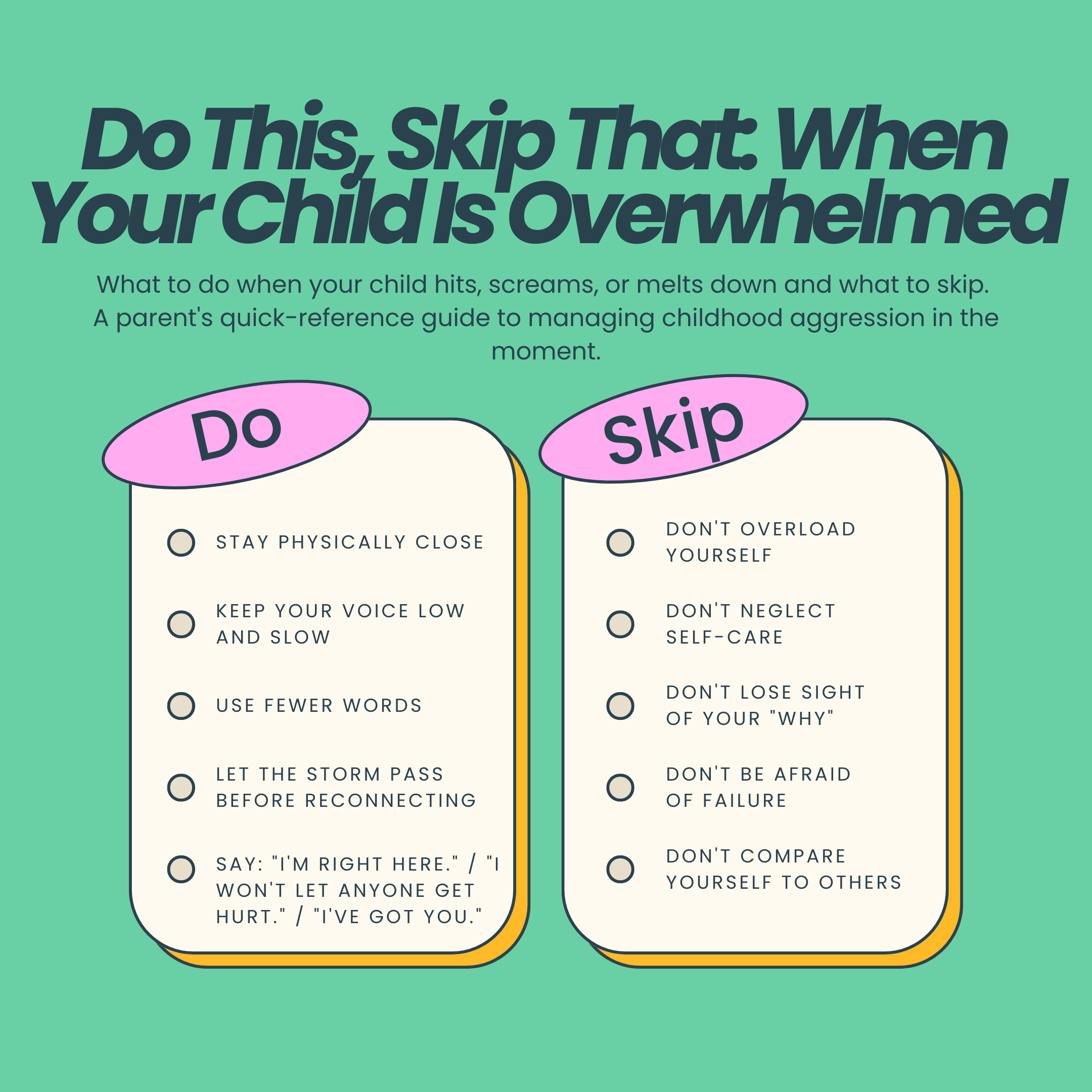
When your child is in the thick of an aggressive episode, your only real job is safety. Not teaching, not consequences, not explaining the problem with their choices. Safety.
Think of yourself as a sailor in a storm. You don’t try to make headway. You don’t lecture the waves. You keep the boat on top of the water, weather it, survive it — and when the storm clears, you rechart your course.
Stay close, stay calm, use as few words as possible:
- “I’m right here.”
- “I won’t let anyone get hurt.”
- “I’ve got you.”
Your calm nervous system literally helps regulate theirs. Children co-regulate — they borrow steadiness from the adults they’re attached to. Your calm isn’t passivity. It’s the most powerful tool you have.
After the Storm: Where the Real Work Happens
Once your child has truly calmed — not suppressed, actually calmed — this is your window. Not for consequences or a replay of what went wrong. For helping them find the path from mad to sad.
1. Name the frustration, not the behavior
“Something really wasn’t working for you.” “That was so disappointing.” Frustration is the only bridge to sadness. Guilt and shame are dead ends.
2. Make space for the sadness
“It’s so hard when we can’t have what we want. You can be sad about it — I’m right here.” When the real tears come, the releasing kind, the storm is genuinely over.
3. Bridge the connection before it hardens
Aggression creates distance — and your child feels it too. Close the gap. That evening: “I really enjoyed reading with you tonight.” Or: “Yesterday was hard. We’re still good.” And when needed: “You are not too much for me.”
A mother once told us that after a fierce tantrum over leaving the park, she stopped explaining and just sat with her daughter in the car: “I know. You didn’t want to leave. You’re so sad.” Real tears came — different from the tantrum ones — lasted about two minutes, then: “Can we have a snack?” Done. That’s the pathway working exactly as it’s meant to. BTW, this is incredibly hard for parents. You are doing two different things at once — holding your limit (leaving the park) and being sensitive (hard to leave when you’re having fun).
Building the Right Conditions Over Time
Managing individual incidents will only get you so far. What actually changes the pattern is what you build between the storms.
Make room for all emotions. When a child learns that frustration or sadness makes you pull away or go cold, those feelings go underground. Underground emotions don’t disappear. They erupt.
Name feelings generously. Not “you’re angry” (which lands like an accusation), but “there’s some frustration here” or “that was so disappointing.” A child who can say “I’m SO frustrated” doesn’t need to throw the toy. The word becomes the outlet.
Prioritize play. Messy, physical, child-led play is emotional work. Pillow fights, tower-knocking, monster pretending — these give frustration a healthy exit.
Take care of yourself. You have your own traffic circle. If you haven’t found your own sadness about the things you can’t control, that frustration will come out as a sharp tone or a consequence born of overwhelm. Find your outlets so you can return regulated, open, and soft.
A Note on Timeline (It’s Not Six Weeks)
Real change is slow. Genuine emotional regulation takes years to develop. Five-to-seven-year-olds are just beginning. Seven-to-nine-year-olds are consolidating. Sensitive kids or those who’ve experienced stress may take longer. Progress isn’t linear — breakthrough weeks will be followed by regression weeks. That’s normal.
Your child is not broken. Neither are you.
Your child is not giving you a hard time. They are having a hard time. The most powerful thing you can offer is not a consequence — it’s a relationship strong enough to hold all of who they are. That is the work. And it is worth every single step.
TLDR — The Framework
- Aggression = emotional problem, not behavioral one
- Root emotion is almost always frustration, not anger
- Frustration needs to move to sadness — that’s the healthy exit
- The #1 source of childhood frustration is separation from attachment figures
- During the storm: safety, closeness, few words
- After the storm: name feelings, make space for tears, bridge the connection
- Over time: build emotional safety, protect tender feelings, play more
This article draws on the developmental framework of Dr. Gordon Neufeld of the Neufeld Institute. For personalized support navigating your child’s emotional development, our Poppins Certified Parent Coaches are here to help.